
JAN VENTER’S EXPOSÉ: I LIVED IT. I OPENED THE ARCHIVE. THEY HAD THE FILE.
Jan Venter’s Exposé trilogy is built as three different tests of the same life across approximately 471,000 words. INSIDER ACCOUNT reconstructs the human record from inside South African power. SO I WROTE AGAIN puts that memory beside the surviving documentary archive — including material that can correct or contradict the narrator. THEY HAD THE FILE follows the record into the institutions that received it. All three manuscripts are complete, all three covers exist, all three official electronic ISBNs have been allocated, and the three ebooks have now entered formal international publishing and distribution with fixed release dates.
ISBN 978-1-0483-7529-9
SO I WROTE AGAIN
ISBN 978-1-0483-7530-5
THEY HAD THE FILE
ISBN 978-1-0483-7531-2
ISBN allocation identifies each publication; it does not verify, endorse or approve the factual contents of the books.
Subscription distribution: Everand and Kobo Plus.
Library distribution: OverDrive, Vivlio Libraries, cloudLibrary, Hoopla and BorrowBox.
Consumer ebook pricing: INSIDER ACCOUNT — US$11.99 (approximately R198); SO I WROTE AGAIN — US$11.99 (approximately R198); THEY HAD THE FILE — US$12.99 (approximately R215). The rand figures are approximate reference conversions based on the 9 October 2026 USD/ZAR rate; final South African or other local-currency retailer prices may differ because of exchange-rate movement, tax, platform conversion and retailer processing. Amazon distribution is managed directly through Kindle Direct Publishing. The other listed retail, subscription and library channels are supplied through the wide-distribution programme. Individual store or library availability can vary by territory and processing time.
Rooted unmistakably in South Africa, the property moves beyond a conventional single-volume political memoir. It begins with lived experience, then exposes that experience to documentary challenge, and finally asks what happened after the record entered official systems. The subject matter reaches into the highest levels of South African political and public life, including senior political office, legal practitioners and advocates, State institutions, investigative and prosecutorial structures, and parliamentary processes, while individual names and specific allegations are left to the books and the underlying record. The human questions travel internationally: what happens when ordinary usefulness becomes proximity to power, when private relationships collide with state institutions, when witness protection and prison enter the same life, and when documents begin to test both memory and public narrative. Much of that record was created while the events themselves were unfolding.
This is not a demand to believe one narrator. It is an invitation to examine a life against the record that survived it: memory beside documents, allegation beside denial, adverse material beside the author’s own account, public narrative beside institutional paper. Start with the Jan Venter Public Record or place the trilogy within the wider field of South African political memoirs.
I PROMISED THE TRUTH FROM THE FIRST PAGE. NEW EVIDENCE REACHED ME ON 19 OCTOBER 2026. I WILL NOT HIDE IT.
This is a dated documentary clarification concerning SO I WROTE AGAIN and the Exposé trilogy, including INSIDER ACCOUNT and THEY HAD THE FILE. The books were already completed, submitted for ebook publication and in international pre-order distribution before this information reached me.
On Monday, , I received an email from a person prominently mentioned in these memoirs. Attached were a criminal court charge sheet and a State psychiatrist’s May 2024 report concerning me. I had not previously received this particular report in that form, despite having sought my medical records from medical institutions. I did not know it contained the opinion now brought to my attention. The email also sent these sensitive records to several other recipients. I did not consent to that circulation.
The psychiatric report records an opinion that, at the time of that 2024 assessment, I was not capable of following criminal proceedings sufficiently to make a proper defence. That differs from my previous understanding and from what I wrote in certain passages of SO I WROTE AGAIN. I acknowledge that difference openly. A psychiatrist’s report is not, by itself, the criminal court’s final order. Nor does it establish why the charges were subsequently withdrawn or determine my capacity today. Those questions must be answered from the proper court record, not from assumption.
The sender is a person identified in my memoirs, yet the source from which that person obtained my psychiatric report and criminal charge sheet, and the legal basis for their onward distribution, have not been explained to me. These are serious, unanswered questions. I am preserving the original correspondence and seeking examination through the appropriate authorities. I will not declare a legal contravention proved before the evidence establishes it, and I will not allow the questions about access to confidential records to disappear.
I refuse to be intimidated into abandoning or delaying the scheduled publication of these South African documentary memoirs because of an email received after the manuscripts were finalised. Revising and redistributing the electronic editions now would entail additional cost and production disruption. I am therefore placing this disclosure on the public record, before the scheduled publication dates, with the full explanation preserved on the Publication Updates page. Honesty was the starting point of these books. It remains the standard by which I expect them to be judged.
HOW AN ORDINARY WORKING LIFE ENTERED THE ORBIT OF POWER.
INSIDER ACCOUNT does not begin with scandal, witness protection or prison. It begins with usefulness — then shows, turn by turn, how practical access becomes personal dependence, political consequence and finally a fight over which version of one life survives.
Work
The entry point is ordinary: security and operations work. There is no political office, press pass or formal investigation — only practical usefulness.
ONE LIFE. THREE RECORDS. THREE DIFFERENT WAYS OF TESTING THE SAME STORY.
The series changes method without changing narrator. Book One restores the human chronology. Book Two subjects that chronology to a documentary test in which the archive is allowed to disagree with memory. Book Three follows the record into the institutions that received it — shifting the question from what happened to what the system did next. That HUMAN → DOCUMENTARY → INSTITUTIONAL architecture is the central distinction of the trilogy within South African political memoirs and political nonfiction.
INSIDER ACCOUNT
The human record. Private proximity, usefulness, money, political conflict, witness protection, prison and the consequences of becoming part of a story larger than yourself.
SO I WROTE AGAIN
The documentary record. Dates, times, emails, WhatsApps, pleadings, investigative material, official correspondence, acknowledgements, denials and contradictions are placed beside memory.
Where the Document Wins
The books do not require a perfect narrator. Where the documentary record corrects recollection, the document wins. Where a matter remains disputed, it remains disputed.
THEY HAD THE FILE
The institutional record. A completed documentary memoir about receipt, referral, investigation, official decision-making, institutional ownership and the gap between a file entering the system and accountability emerging from it.
15 November 2026: THEY HAD THE FILE.
Pre-orders can be placed before those dates on participating platforms. A retailer may show a title page, cover, metadata, sample or preview in advance, but the complete ebook is scheduled for release to readers on the official publication date.
THREE COMPLETED BOOKS. ONE CONTROLLED ARCHIVE. MULTIPLE RIGHTS PATHWAYS.
The property can be approached title by title, as a connected three-book series, or as one underlying true-life screen and factual property. Across approximately 471,000 words in three completed manuscripts, the material offers a finished narrative foundation, a controlled documentary archive and multiple screen, documentary, audio, translation, territorial and adaptation rights pathways. INSIDER ACCOUNT publishing and print rights are no longer available. Select a pathway below.
INSIDER ACCOUNT
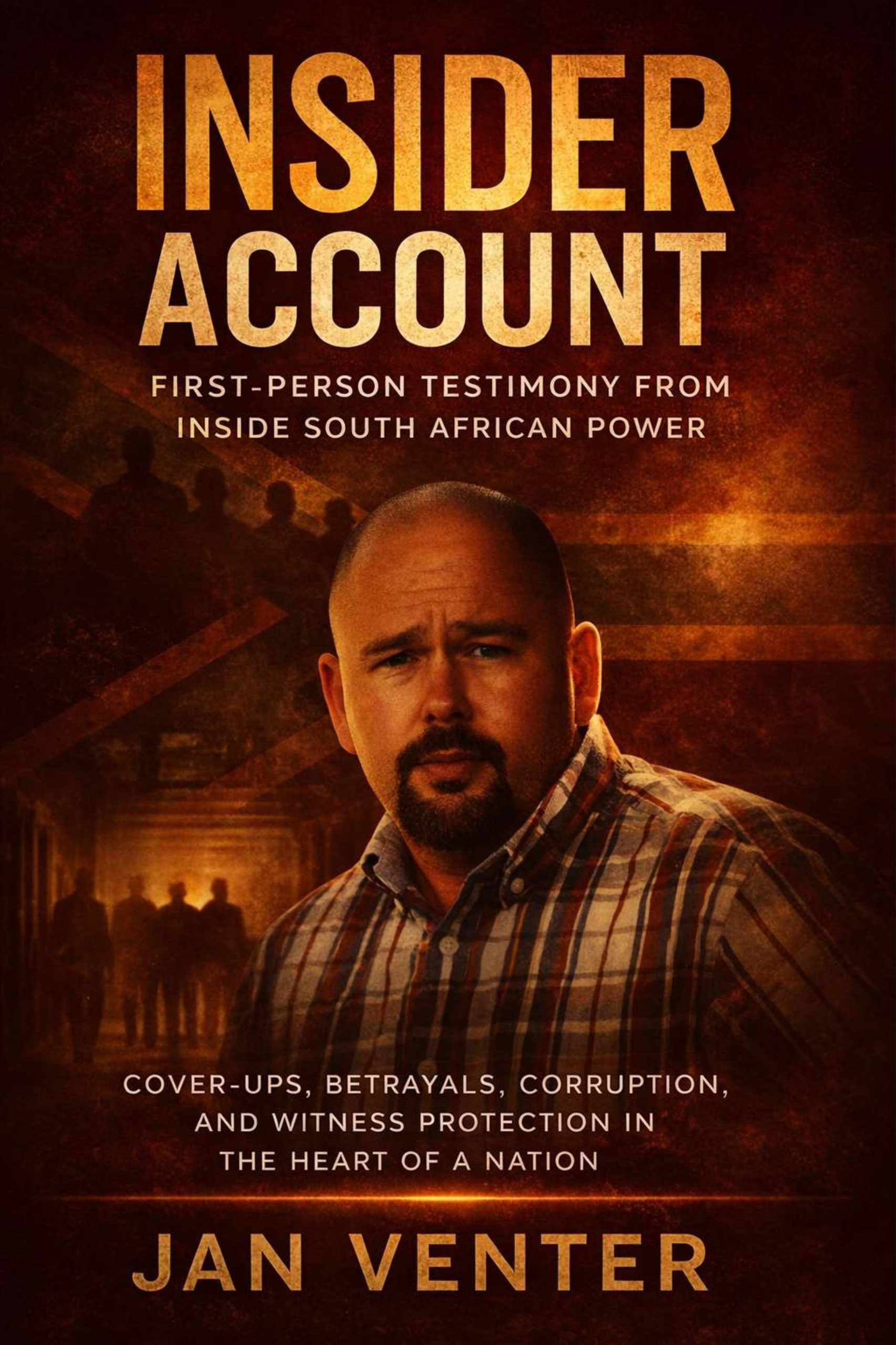
Pre-order underway • full ebook release 31 Oct 2026 US$11.99 • approximately R198 Official NLSA electronic ISBN: 978-1-0483-7529-9A completed first-person South African political memoir with a continuous human arc from ordinary work and private access through political entanglement, State structures, witness protection, prison and reconstruction.
The book stands independently, while also functioning as the first movement in a larger nonfiction property. Its publishing and print rights are no longer available; screen, documentary, audio, translation, territorial and adaptation rights remain open.
SO I WROTE AGAIN
Pre-order underway • full ebook release 31 Oct 2026 US$11.99 • approximately R198 Official NLSA electronic ISBN: 978-1-0483-7530-5When the Witness Became the Problem. The second book returns to the archive: emails, messages, official correspondence, court papers, investigative material, witness-protection records, dates, timestamps, acknowledgements, responses and contradictions.
Its central discipline is simple: memory is part of the record, not the whole record.
THEY HAD THE FILE
Pre-order underway • full ebook release 15 Nov 2026 US$12.99 • approximately R215 Official NLSA electronic ISBN: 978-1-0483-7531-2The third book moves the centre of gravity from memory and reconstruction to institutional conduct: what happened after public bodies, oversight structures and criminal-justice institutions received the record.
Its discipline remains documentary rather than declaratory. Receipt is not validation. Referral is not resolution. A later public development does not automatically prove an earlier allegation. The book asks what the record establishes, what remains disputed and what happened after the file entered the system.
Film / Premium Limited Series
Rights enquiries openThe underlying chronology already contains long-form dramatic escalation: ordinary work, private access, money, competing interests, state structures, witness protection, collapse, prison, documentary reconstruction and finally the institutions that receive the record.
The screen proposition is human before it is political. One life moves through increasingly consequential worlds while the paper trail grows around him — allowing past events and later documents to interrogate one another on screen.
Documentary / Docuseries
Archive-led potentialThe project can support factual treatment in which present-day testimony is tested against contemporaneous communications, public reporting, official responses, litigation, investigative records, adverse findings, denials and competing accounts.
Selected source material may be made available for professional verification on a controlled, purpose-specific basis, subject to applicable law, privacy obligations and court orders.
International / Translation / Audio
Rights enquiries openSouth Africa supplies the specificity. The dramatic questions travel: proximity to power, loyalty, money, institutional credibility, witness protection, public reputation, survival, evidence and the contest over who gets to define the record.
Territorial, translation, foreign-language, audiobook, narrative-audio and related rights enquiries are invited through Exposé, subject to the existing publication position of each title.
THE STORY IS HUMAN. THE RECORD IS TESTABLE.
The books do not ask a professional reader to confuse memoir with proof. Their strength is the opposite: separate memory, allegation, denial, inference, judicial finding, institutional receipt and documentary material — then preserve enough of the record for serious scrutiny. The source-led Public Record is the site’s central verification route for readers, journalists, researchers, publishers and producers who want to test the surrounding record rather than rely on promotional description.
THE DOCUMENT DOES NOT HAVE TO AGREE WITH THE AUTHOR.
SO I WROTE AGAIN and THEY HAD THE FILE are stronger precisely because the archive is not treated as decoration. A payment proves a payment, not automatically its purpose. A message proves communication, not automatically the truth of everything said in it. A pleading proves what a party pleaded, not automatically the underlying fact. Institutional receipt proves receipt — not agreement with what was received.
Where the documentary record corrects recollection, the document must win. Where the record remains incomplete or disputed, the uncertainty remains visible.
PROFESSIONAL DUE DILIGENCE
- Important chronology can be placed beside surviving source material where available.
- Relevant denials, opposing versions and adverse material remain part of the record.
- Pre-publication opportunities to comment have been used where appropriate and are preserved separately from the truth of the underlying dispute.
- Confidential material remains controlled and subject to applicable law, privacy obligations and existing court orders.
WHY THIS SOUTH AFRICAN STORY TRAVELS.
The institutions, history and texture are South African. The human engine is not confined by geography: how an ordinary person enters the orbit of power, what access does to judgment, what institutions do with inconvenient records, what happens when public and private worlds collide, and who controls a reputation once one version hardens into history. For readers following the political and institutional context beyond the trilogy itself, Exposé maintains separate source-led records on Mathews Phosa and the Exposé record, David Mabuza and the Mpumalanga public record, and Witness Protection, Hawks/DPCI, the NPA and related state-institution records.
Power Seen From Below
The camera angle is reversed. This is not the office-holder explaining the system from above; it is the participant whose usefulness opened doors before he understood their cost.
Built-In Narrative Escalation
The chronology already moves through private access, public power, litigation, journalism, state institutions, witness protection, prison and a substantial documentary trail. The dramatic escalation exists in the underlying life; adaptation does not need to manufacture it.
A Finished Foundation
Three books are complete, each with a distinct narrative function, while the wider public record continues to develop. That gives producers, documentary teams and other professional evaluators a finished foundation rather than a promise — with Book Four already in development.
THREE BOOKS ARE COMPLETE. ADAPTATION AND OTHER RIGHTS ARE OPEN. THE RECORD IS CONTROLLED.
Serious international and South African film, television, documentary, audio, translation, territorial, adaptation and controlled-archive enquiries are invited through the official route. INSIDER ACCOUNT publishing and print rights are closed, while its other rights remain open. The commercial proposition is not one unfinished concept: it is a completed three-manuscript corpus with distinct human, documentary and institutional movements, supported by a controlled verification record and adaptable as individual titles or one connected property.
Publication Status
The release schedule is now fixed and public. INSIDER ACCOUNT and SO I WROTE AGAIN release on 31 October 2026; THEY HAD THE FILE releases on 15 November 2026. Pre-orders are underway and international retail, subscription and library distribution is active. INSIDER ACCOUNT publishing and print rights are no longer available.
Film & Television
Feature, scripted adaptation, premium limited-series and related screen-rights enquiries.
Documentary
Documentary, docuseries and archive-led factual development.
Audio & Podcast
Audiobook, narrative audio, podcast and related adaptation enquiries.
International
Territorial, translation, foreign-language, foreign-market and international representation enquiries.
Archive / Research
Controlled professional verification and research access where lawful and appropriate.
Request the appropriate professional package.
The full manuscripts and confidential archive are not published indiscriminately. Professional materials are supplied according to the recipient, territory, purpose and stage of serious engagement.
READERS ASK WHAT COMES NEXT. THE INDUSTRY ASKS WHO CONTROLS THE RIGHTS.
Both questions belong here. The publication schedule is now fixed and public: INSIDER ACCOUNT and SO I WROTE AGAIN release on 31 October 2026, and THEY HAD THE FILE releases on 15 November 2026. Pre-orders are underway on participating platforms, while complete ebooks are scheduled for delivery on the official publication dates. Screen, documentary, audio, translation, territorial, adaptation and verification approaches remain open across the completed property; INSIDER ACCOUNT publishing and print rights do not.
Readers & Publication
Release dates, pricing, distribution and publication updates