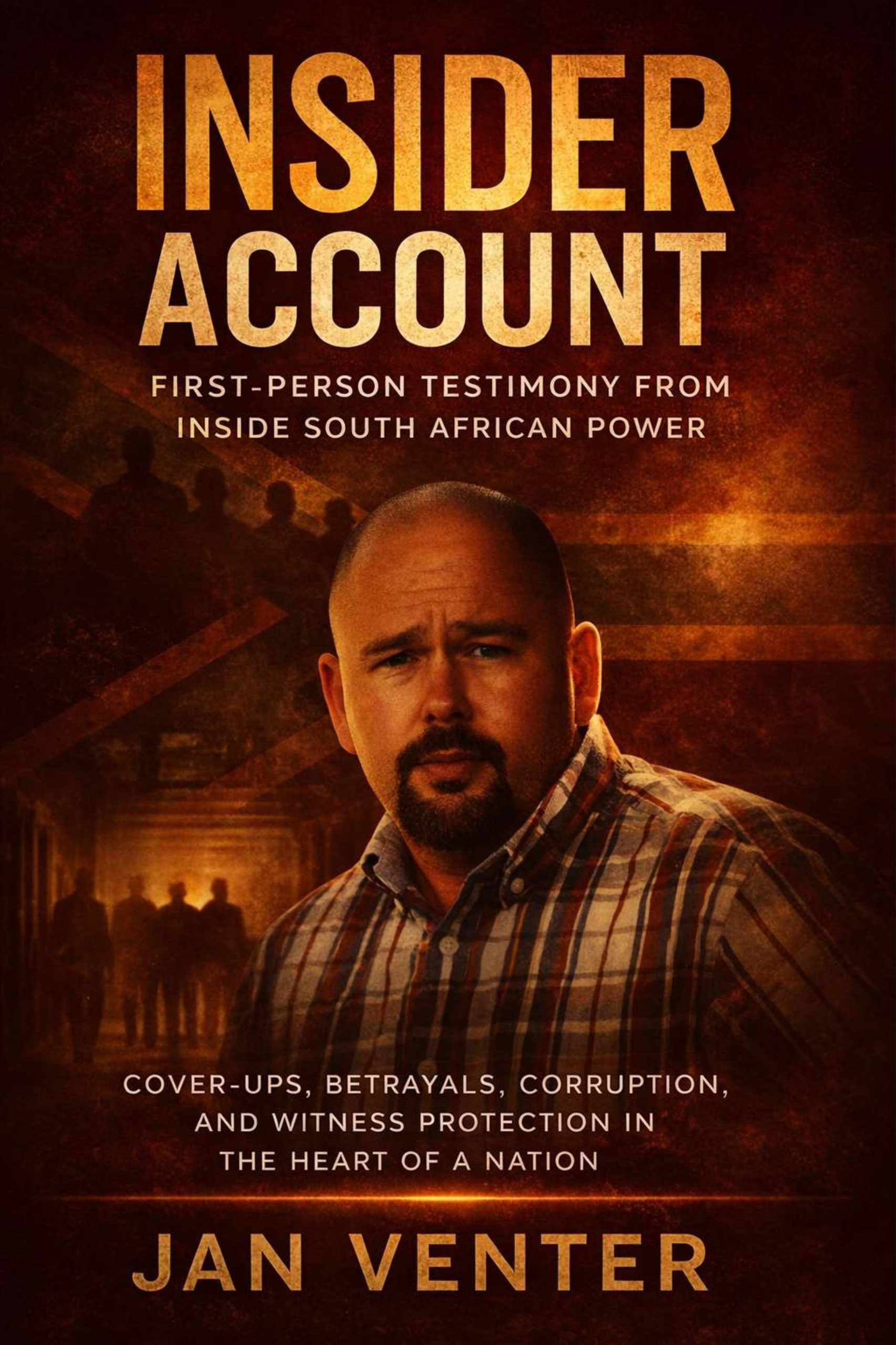
JAN VENTER: HE DIDN’T ENTER POWER WITH A TITLE. HE ENTERED BECAUSE HE WAS USEFUL.
Jan Venter is a South African author, participant and archive custodian, and the creator of Exposé, the publishing, documentary and Public Record platform behind INSIDER ACCOUNT, SO I WROTE AGAIN and THEY HAD THE FILE. The three completed nonfiction manuscripts trace one continuing life from ordinary security and operations work into private political proximity, competing interests, state structures, witness protection, public controversy, prison and, eventually, a deliberate reconstruction of the record that survived it.
He was not an elected politician, party office-holder, journalist or formal investigator. His access came through work: security, operations, logistics, problem-solving, trust and the practical responsibilities that accumulate around people with power. That starting point is central to his place within South African political memoirs: the story begins below formal office, with usefulness, and only later acquires political consequence.
That position is what makes the series different. Venter was not sent in to observe somebody else’s ecosystem and reconstruct it later. He became part of the chronology. His name entered journalism, litigation, official responses and competing public accounts while emails, messages, photographs, financial material, court records, investigative material and other documentary traces of the life survived around him. The Exposé Public Record organises that public-source history where it intersects with Mathews Phosa, David Mabuza and the South African institutional record involving witness protection, the Directorate for Priority Crime Investigation (DPCI/Hawks), the National Prosecuting Authority (NPA) and later Madlanga Commission material — while keeping allegation, denial, finding, referral, receipt and later development distinct.
The books do not ask readers to accept a polished version of their author. Attraction to status, money, poor judgment, contradiction, fear and compromise remain in the story where they belong. Nor does the trilogy rely on one mode of authority. INSIDER ACCOUNT carries the human record; SO I WROTE AGAIN subjects memory to documentary scrutiny; THEY HAD THE FILE follows what happened after institutions themselves received the record. The author is therefore not presented as the final proof. He is one part of the material to be tested.
An ordinary operational man becomes useful inside private political power, becomes consequential without holding formal authority, survives the fallout, and years later puts his own memory beside the documents that survived it — before asking what happened when those records entered institutions with the power to act.
THE SERIES DOESN’T NEED A PERFECT HERO. IT NEEDS THE MAN WHO WAS THERE.
Venter’s value as a central character is not prestige. It is trajectory: ordinary work becomes access; access becomes entanglement; entanglement becomes consequence; and consequence eventually produces a public and documentary record that the narrator has to confront himself. For readers and screen producers, that creates a protagonist who changes position repeatedly while the evidentiary world around him becomes more demanding, not less.
Ordinary Entry Point
Security, operations and practical problem-solving create the initial route into a world that appears much larger only in hindsight.
Access Without Office
Private proximity grows through usefulness and trust rather than political title, formal mandate or public authority.
A Flawed Participant
Status, money, judgment, contradiction and compromise remain part of the character arc instead of being edited away.
The Record Turns Back on Him
Later journalism, litigation, official versions and preserved documents force the narrator to account not only for what happened around him, but for his own role inside it.
FIVE POSITIONS. ONE CONTINUING LIFE.
Select a lens. The same man occupies radically different positions across the series — and the story becomes more valuable as those positions begin to collide with one another.
The Operator
The story begins with function: security, logistics, operations and practical usefulness. The early Jan Venter is valuable because he can solve problems, not because he has political standing.
POSITION MATTERS MORE THAN TITLE.
The series becomes easier to understand once the narrator’s position is defined precisely.
He did not enter as:
- A politician explaining his own administration or party career.
- A journalist arriving later to reconstruct the lives of other people.
- A formal investigator sent into the environment under an official mandate.
- A detached commentator analysing events from a safe distance.
He entered as:
- An operations man whose value began with practical work and problem-solving.
- A trusted participant whose access expanded through usefulness and private confidence.
- A subject of the record who later appeared in journalism, litigation and competing public versions.
- An author and archive custodian now placing his own chronology beside the surviving material.
The political significance comes later. That is what gives the story its dramatic engine: the audience watches an ordinary role become something much larger before the narrator himself fully understands the change — and then watches the later record challenge his own memory of it.
THE BOOKS DO NOT ASK THE READER TO ADMIRE HIM FIRST.
They ask harder questions: who was Jan Venter really, what did he do, what did he misunderstand, what did he compromise, what did others say about him, and what remains when memory is placed beside the surviving record?
Status
The attraction of proximity and importance is part of the story rather than something the series pretends never existed.
Money
Financial relationships and transactions are confronted according to the surviving record and their place in the chronology.
Judgment
Poor decisions, contradictions, inconsistencies and uncomfortable choices remain visible where they materially shape the narrative.
Documentary Correction
Where a document corrects recollection, the document wins. Where a matter remains disputed, it remains disputed.
FOR YEARS, SOME PEOPLE TREATED THESE BOOKS AS IF THEY WOULD NEVER EXIST. NOW THEY DO.
For years, people with influence, public platforms and institutional reach could look at what I was saying and assume that the books would remain an idea, that the record would never be assembled, or that the story would eventually disappear under the weight of everything that had already been said about me. I know that some regarded it as exaggeration or imagination. That question is over. The manuscripts are complete. The ISBNs are allocated. The release dates are fixed. Pre-order distribution has begun.
I have spent years trying to put the record back together because I maintain that serious falsehoods and distorted versions of my life were published, repeated or accepted about me — in public reporting, in institutional processes and in the wider public narrative. I do not expect anybody to accept that merely because I say it. That is why the books preserve adverse material, competing versions, court records, official correspondence and documents capable of testing my own memory as well.
I have been through witness protection, prison, litigation, interdicts, public accusations and years of continuing disputes. I have been through hell and back. That experience did not teach me that I am above the law. It taught me something almost opposite: that if I want the record tested, I have to keep using the law, keep putting documents before the institutions and courts that can deal with them, and keep pursuing every lawful route available to me.
There are ongoing legal proceedings and unresolved disputes. This page does not ask anyone to prejudge them. My position is simpler: I will not abandon the record because a process is difficult, because an allegation is repeated often enough, or because challenging an established version is uncomfortable.
I will comply with lawful court orders and lawful process. I will also use every lawful right available to challenge what I say is false, place evidence on record and seek decisions from the bodies empowered to make them.
I have learned not to assume that a headline, an institution or the passage of time will repair a reputation on my behalf. Where I believe the record is wrong, I will continue to contest it through evidence, legal process and publication.
The books are now moving through third-party publishing and distribution systems. The work is no longer a private manuscript sitting on one device or dependent on whether somebody believes I will eventually finish it.
This is not revenge, and it is not an invitation to ignore the law. It is the opposite: a refusal to surrender the record. I will continue, lawfully and on the evidence, until the material has been tested as fully as the available processes allow and the public can read the books and reach its own conclusions.
SOUTH AFRICAN SETTING. UNIVERSAL HUMAN ENGINE.
The property sits at the intersection of South African political memoir, documentary nonfiction and institutional accountability. The politics and institutions are South African. The character arc is not: usefulness, access, ambition, dependence, compromise, fear, loss of control, survival, reputation and the struggle to reclaim a narrative are legible in any market.
An Accessible Entry Point
The audience enters through an ordinary working person rather than through a constitutional office, party hierarchy or elite institution.
Transformation on Screen
The central character changes visibly across the chronology: worker, insider, participant, contested figure, protected witness, prisoner, survivor, author and custodian of the record.
A Record Behind the Character
The Exposé Public Record gives publishers and producers a professional route to test important parts of the chronology against public reporting, court records and institutional material without pretending every contested proposition is already proved.
THE HUMAN RECORD. THEN THE DOCUMENTARY RECORD.
INSIDER ACCOUNT reconstructs the lived journey from ordinary operational work into private political proximity and through the consequences that followed.
SO I WROTE AGAIN returns to the emails, messages, official correspondence, court papers, investigative material, witness-protection records, dates, timestamps, acknowledgements, denials and contradictions that survived around that life.
THEN THE REPUBLIC HAD THE FILE.
THEY HAD THE FILE moves the story from the human and documentary record into the institutional record: what happened after complaints, submissions, correspondence and supporting material reached bodies capable of receiving, assessing, referring, investigating or deciding them. The related State Institutions & Exposé Record page gives that institutional question its own public-source route.
The method remains the same: receipt is not proof, allegation is not finding, and a later decision is not rewritten into vindication. The book records the chronology, the documentary trail, the institutional responses and the disputes that remain.