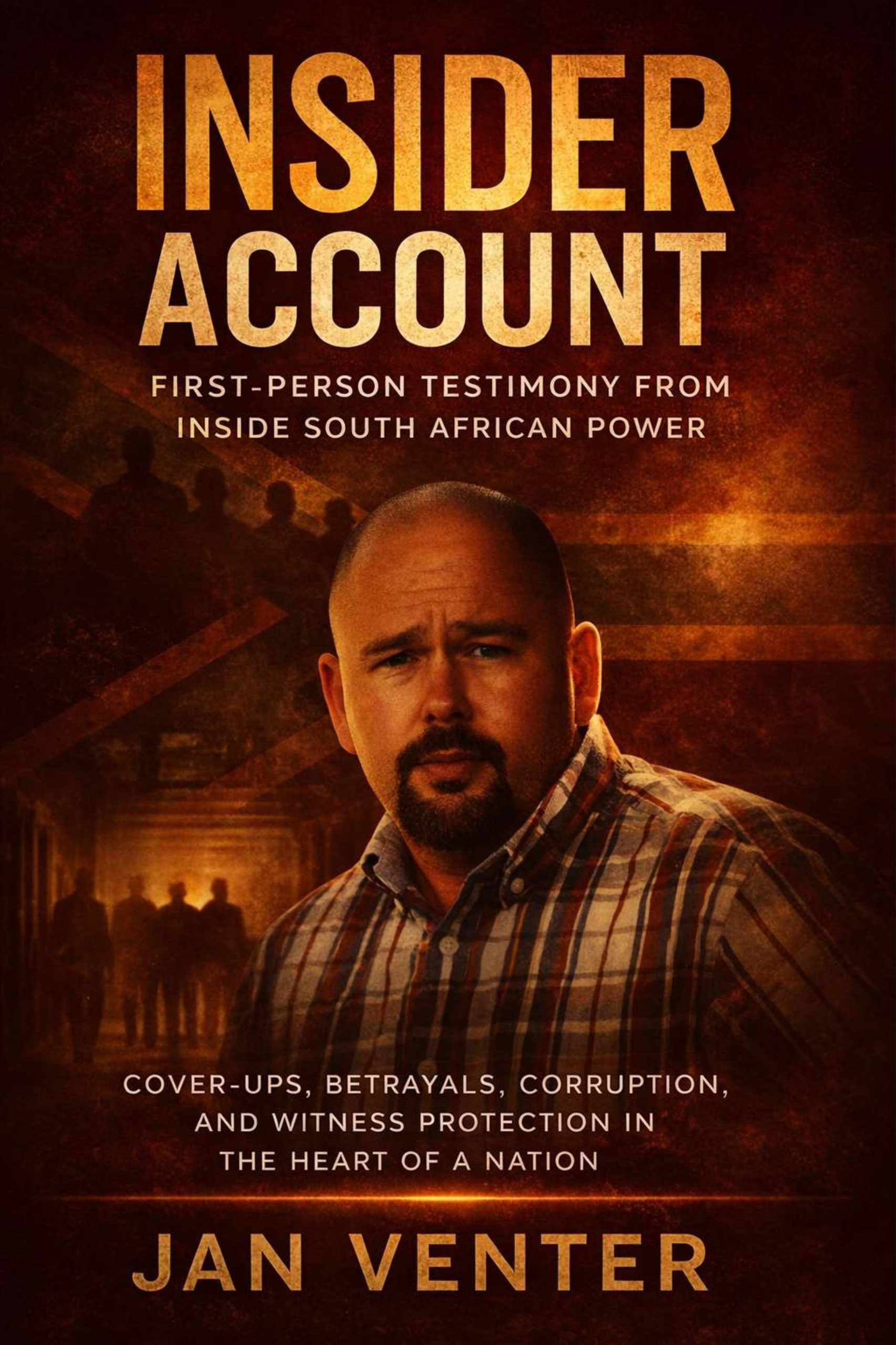
THE HEADLINES MOVED ON. THE RECORD DID NOT.
INSIDER ACCOUNT records what Jan Venter says he lived. SO I WROTE AGAIN puts the surviving paper beside that memory. THEY HAD THE FILE follows what happened after institutions themselves received the record. Together they form a completed South African political-memoir and documentary-nonfiction trilogy of approximately 471,000 words — not one retrospective version asking to stand alone, but a human record, a documentary record and an institutional record built to be read against one another.
That distinction matters now. Public narratives harden quickly: a television interview, a political statement, a court headline or an institutional response can become the version remembered long after the underlying chronology has disappeared from view. Exposé puts the chronology back on the table. The Jan Venter Public Record can be read beside dedicated source-led records concerning Mathews Phosa, David Mabuza and the State institutions that received or handled parts of the record.
The national context is still moving. South Africa’s Madlanga Commission of Inquiry into Criminality, Political Interference and Corruption in the Criminal Justice System is continuing its work. On 19 September 2026, the Presidency extended the Commission’s final-report deadline to 25 January 2027 so that additional evidence, including expert testimony, can be processed. The Presidency has also publicly recorded recommendations and referrals arising from the Commission’s second interim report. None of that proves Venter’s earlier allegations. It does something different and important: it creates a contemporary institutional record against which older claims, denials, public statements and documented chronology can be compared.
The publication position has now moved beyond intention. As at 9 October 2026, all three manuscripts are complete, their covers and publication metadata are prepared, official electronic ISBNs have been allocated by the National Library of South Africa, and fixed ebook release dates have been entered into the international publication and distribution systems. INSIDER ACCOUNT — ISBN 978-1-0483-7529-9 — releases 31 October 2026 at US$11.99 (approximately R198); SO I WROTE AGAIN — ISBN 978-1-0483-7530-5 — releases 31 October 2026 at US$11.99 (approximately R198); and THEY HAD THE FILE — ISBN 978-1-0483-7531-2 — releases 15 November 2026 at US$12.99 (approximately R215). Pre-order distribution is underway. Retailer listing times can differ, but customers who pre-order do not receive the complete ebook before its scheduled release date; individual retailers may display a limited preview or sample in advance.
There is also an immediate democratic context. South Africa’s Local Government Elections are scheduled for 4 November 2026. INSIDER ACCOUNT and SO I WROTE AGAIN are scheduled for release on 31 October 2026, before that election; THEY HAD THE FILE follows on 15 November 2026. The books are not campaign literature and Exposé does not tell any reader which party or candidate to support. The timing matters only because public power, institutional accountability and the documentary record are matters readers are entitled to examine for themselves.
That is why this property cannot be reduced to another political memoir. The South African Political Memoirs record explains the wider genre. Exposé’s proposition is narrower and harder: memory must submit to documents where documents exist; public statements can be tested against chronology; institutional receipt must be distinguished from institutional validation; and no public reputation is strengthened by pretending inconvenient records do not exist.
The proposition is not “believe Jan Venter.” It is: read what was said then, read what was denied then, examine what survived, examine what institutions later recorded, keep adverse material in view — and decide what survives comparison. Power can move on. The record can still answer.
THE BOOKS ARE NO LONGER A PROMISE. THE DATES ARE FIXED. THE DISTRIBUTION HAS STARTED.
For years, people could dismiss the project as something that might never leave a private manuscript. That position is no longer available. The three books are complete, the ISBNs are allocated, publication metadata and files have been submitted into external publishing and distribution systems, and the release dates are fixed. This does not ask anyone to accept Jan Venter’s version of events as fact. It means the record he has spent years assembling is moving into public distribution where readers can examine it for themselves.
INSIDER ACCOUNT
First-Person Testimony from Inside South African Power.
Release: 31 October 2026.
Electronic ISBN: 978-1-0483-7529-9.
Ebook: US$11.99 • approximately R198.
Status: Pre-order distribution underway; full ebook supplied on the scheduled release date.
SO I WROTE AGAIN
When the Witness Became the Problem.
Release: 31 October 2026.
Electronic ISBN: 978-1-0483-7530-5.
Ebook: US$11.99 • approximately R198.
Status: Pre-order distribution underway; full ebook supplied on the scheduled release date.
THEY HAD THE FILE
What Happened After the Republic Received the Evidence.
Release: 15 November 2026.
Electronic ISBN: 978-1-0483-7531-2.
Ebook: US$12.99 • approximately R215.
Status: Pre-order distribution underway; full ebook supplied on the scheduled release date.
Amazon Kindle is being handled directly through Kindle Direct Publishing. Wide ebook distribution has been submitted through Draft2Digital for Apple Books, Barnes & Noble / NOOK, Kobo, Tolino, Vivlio, Smashwords, Gardners, Bookshop.org and Fable, with subscription availability through Everand and Kobo Plus and library distribution through OverDrive, Vivlio Libraries, cloudLibrary, Hoopla and BorrowBox. Individual retailer and library-platform listing times can vary. Google Play Books is not part of the current distribution programme.
WHAT WAS RECORDED THEN CAN NOW BE READ BESIDE WHAT SOUTH AFRICA IS HEARING NOW.
The public-interest value is no longer merely that one man has written his version. The stronger proposition is architectural: a first-person chronology, a documentary reconstruction and a completed institutional third movement can now be placed beside later public records without pretending that they automatically agree.
The Earlier Record Exists
The Exposé Public Record aligns journalism, court material, official denials, correspondence, investigative material and public statements so readers can see what was being said and recorded years before the trilogy was completed.
The Institutional Record Is Still Moving
The State Institutions record can now be read in a national environment where the Madlanga Commission continues examining criminality, political interference and corruption in the criminal justice system. That later process is context, not automatic validation.
The Document Can Defeat Memory
SO I WROTE AGAIN does not use documents as decoration. Where a reliable document corrects recollection, the document wins. Where a matter remains disputed, the dispute stays visible.
The File Became the Question
THEY HAD THE FILE asks what happened after institutions received material: what was acknowledged, referred, investigated, delayed, decided, disputed or left unresolved. Receipt is not validation — but receipt is part of the record.
PUBLIC POWER DOES NOT COME WITH A RIGHT TO BE UNQUESTIONED.
Politicians, public officials and institutions enter public life through office, television appearances, speeches, official statements, litigation, policy decisions and the exercise of public authority. Their public conduct and public claims can be examined, compared with records and challenged where the evidence warrants it. Visibility does not make every allegation true. It does mean that public reputation cannot sensibly be treated as a shield against documented scrutiny.
What scrutiny is entitled to ask
- What was said publicly? Put the statement beside the earlier and later record.
- What actually reached an institution? Separate acknowledgement, referral, investigation and decision.
- What contradicts the preferred version? Keep denials, adverse findings and contrary records visible.
- What can the evidence prove? Stop at the evidentiary limit instead of inflating the conclusion.
What Exposé refuses to do
- Public status is not proof of wrongdoing: office, fame or controversy does not prove an allegation.
- Scrutiny is not a licence to invade irrelevant private life: the focus remains public conduct, public record and documented professional or institutional intersections.
- Jan Venter gets no exemption: where a document, judgment or contrary record cuts against his memory, it remains part of the record.
- No institutional pedigree is required to ask a documented question: accuracy, sourcing and fairness matter more than whether the question comes from a newsroom, NGO, commission, legal team or an individual citizen.
WHY THE STORY FEELS CURRENT WITHOUT BECOMING A NEWS PRODUCT.
Select a pressure point. These tensions survive individual office-holders, elections and headlines — which is precisely why the property can remain relevant after today’s news cycle moves on.
Who Controls the Narrative?
Public stories harden quickly. A television interview, political statement, allegation, finding or headline can become shorthand long before the full chronology is assembled. Later scrutiny therefore has to compete not only with memory, but with reputations and narratives already invested in being believed.
SOUTH AFRICAN IN DETAIL. INTERNATIONAL IN HUMAN LOGIC.
The names, institutions and history are South African. The emotional and institutional machinery is not. Select a lens to see why the property can travel beyond the country in which it occurred.
Human
Ambition • access • dependence • fear • survivalThe political context may be unfamiliar to an international reader. The human engine is not: usefulness, status, trust, money, compromise, dependence, isolation, fear and the attempt to regain control of one’s own story.
An audience does not need to understand every South African institution before understanding what proximity to power can do to an ordinary person.
Institutional
Trust • process • protection • accountabilityReaders across democracies understand the tension between institutional promise and lived experience. The series approaches that tension from the person who must depend on the system rather than from the official explaining it.
That “from below” perspective gives the material relevance beyond the exact agencies and offices in the South African chronology.
Documentary
First-person testimony beside competing recordsThe factual proposition is unusually strong because the narrator’s version can be placed beside communications, reporting, official material, court records, denials, adverse findings and later institutional evidence where available.
That allows a documentary to build tension from competing records rather than relying only on retrospective testimony.
Screen
Transformation rather than expositionThe dramatic engine is visible transformation: ordinary worker, trusted insider, participant, protected witness, contested public figure, prisoner, survivor and finally narrator of the surviving record.
Book Two adds the older man returning to the archive and discovering that memory itself must submit to the paper. Book Three adds a third engine: the file enters institutions, and the question becomes what those institutions actually do with it.
International
South Africa under a wider global lensThe books are rooted in South Africa, but their dramatic logic does not require an international reader to arrive with prior knowledge of South African politics. The property can be understood as political memoir, documentary nonfiction and institutional-accountability storytelling without reducing it to a single headline or allegation.
Readers, producers and rights professionals can enter through a universal human story — access, usefulness, dependence, fear, survival and narrative control — and then discover the deeper institutional and documentary architecture underneath it.
NO COMMISSION, POLITICIAN OR INSTITUTION GETS TO CERTIFY THE TRUTH FOR THE READER.
The trilogy does not need a commission, political party, public official, newsroom or foreign government to certify Jan Venter. Nor does it ask readers to accept institutional silence as exoneration or institutional action as proof. Its stronger value is that the competing records can be placed beside one another and tested on their own terms.
This page does not claim:
- Madlanga proves Jan Venter right: the Commission’s work is a later public record, not a blanket certificate for earlier allegations.
- International attention validates the books: global relevance creates opportunity for discovery, not proof of any allegation.
- The narrator is spotless: self-implication, adverse findings, contradiction and poor judgment remain part of the story.
- A conspiracy is the only explanation: documentary touchpoints create questions that must still be tested.
Its relevance does rest on:
- Contemporaneous records: parts of the chronology were documented while events were unfolding.
- Later public records: subsequent institutional evidence can now be compared with what existed earlier.
- Documentary discipline: memory, allegation, denial, inference and finding are not treated as interchangeable.
- Human consequence: the institutional questions are experienced through one life rather than discussed only in abstraction.
THE STORY IS NOT WAITING TO BECOME A PROPERTY.
Three books are complete — approximately 471,000 words across a finished human record, documentary reckoning and institutional third act. The archive and verification architecture already exist. Publication and distribution of the three books are now underway, while producers and rights professionals can evaluate the South African political-memoir and documentary property for screen, documentary, audio, translation and other subsidiary-rights development.
Publication Dates Fixed
Three completed manuscripts with three official electronic ISBNs. INSIDER ACCOUNT and SO I WROTE AGAIN release on 31 October 2026; THEY HAD THE FILE releases on 15 November 2026. Pre-order distribution is underway across the participating retailer network.
Documentary
A story built around first-person testimony, contemporaneous material, adverse records, official responses and institutional handling — with a later public record still developing around the broader national context.
Film & Television
A transformation arc moving from ordinary work through private access, political entanglement, protection, collapse, imprisonment and reconstruction — with the archive as a second timeline and institutional receipt as a third dramatic layer.
International Rights
A distinctly South African true-life story with internationally legible themes of power, loyalty, witness dependence, institutional trust and documentary accountability — with translation, audio, film, television, documentary and other subsidiary-rights pathways open to serious enquiry.