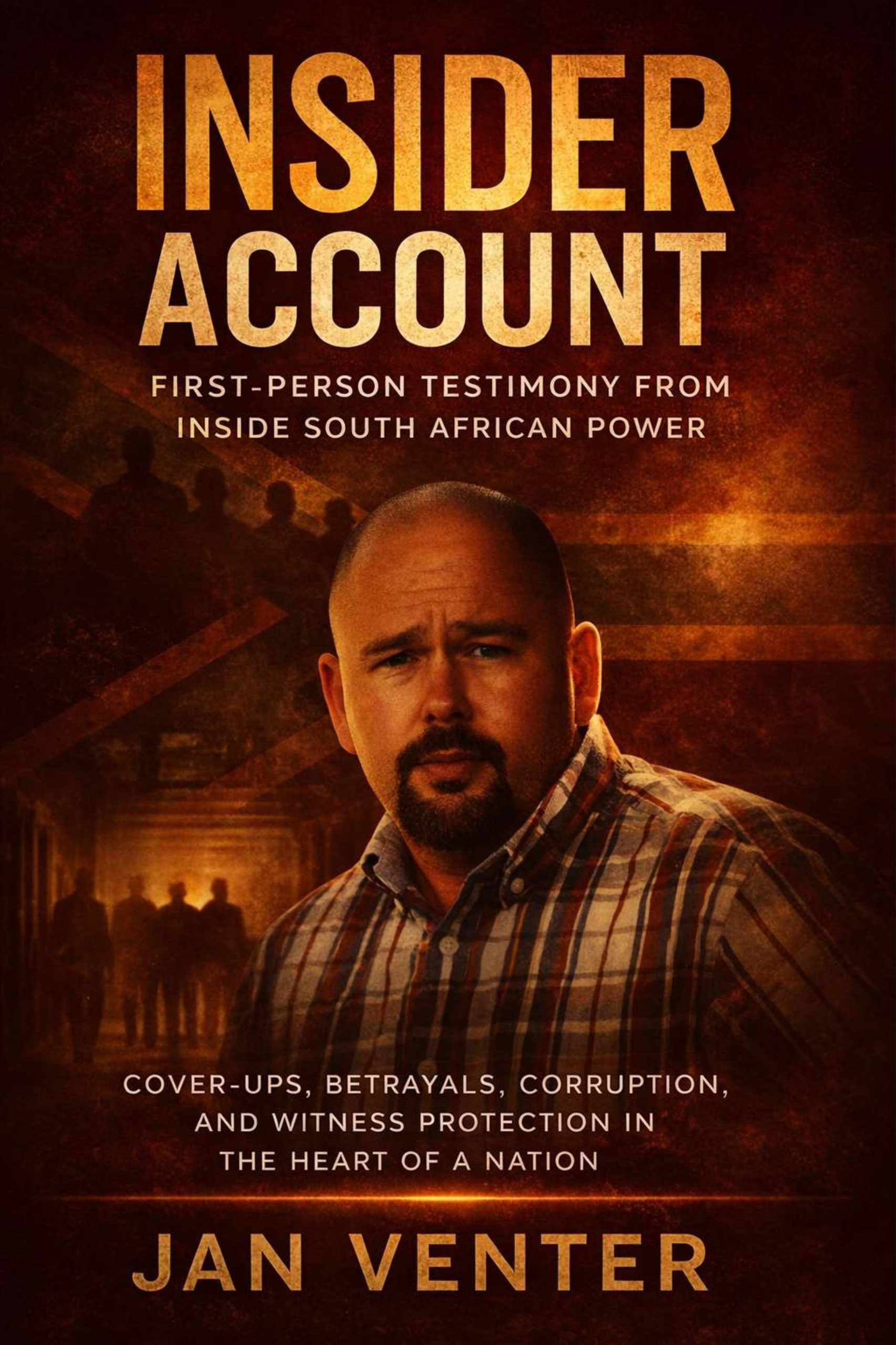
WITNESS PROTECTION, HAWKS, NPA & MADLANGA COMMISSION: THEY HAD THE FILE. NOW EXPLAIN THE RECORD.
One arm of the State placed Jan Venter in witness protection. The Hawks later described a prosecutor-guided investigation containing more than 50 affidavits and bank statements. Prosecutorial reasons later characterised the matter substantially through the credibility of “largely a single witness”. The national prosecution office then requested a report and the relevant docket. The Madlanga Commission later told Venter that his matter was with its investigative team.
None of those events proves criminal guilt. None proves that every allegation was true. But taken together, they create a State-authored accountability problem: if these official descriptions are all capable of standing together, where is the documented bridge that explains how?
This page does not ask South Africa’s institutions to believe Jan Venter. It asks them to account for their own placement decisions, their own investigation, their own docket, their own prosecutorial reasoning, their own review path and their own Commission correspondence.
THE STORY IS NOT “BELIEVE JAN VENTER”. THE STORY IS “MAKE THE STATE EXPLAIN ITS OWN FILE”.
Exposé separates a witness’s allegations from institutional conduct. A witness can be wrong. A prosecutor can lawfully decline a case. A protection programme can end. A Commission can receive material without adopting it. But none of those propositions gives public institutions permission to read their own record selectively.
What Venter says
His recollections, admissions, allegations and later documentary reconstruction remain attributed to him. They do not become findings merely because they appear in a book or submission.
What the State itself recorded
Placement decisions, official letters, case references, a formal criminal docket, prosecutorial reasons, review correspondence and Commission acknowledgements are State-created records. They must be read for what they actually say — including when they sit uneasily beside one another.
What institutions still have to explain
Where two official descriptions appear materially different, the answer is not rhetoric. It is the underlying evidential bridge: what was obtained, what was accepted, what was rejected, why, by whom, and what happened next.
THE STATE CANNOT HAVE EVERY VERSION AT ONCE WITHOUT EXPLAINING THE BRIDGE BETWEEN THEM.
This is where the institutional criticism becomes severe without becoming speculative. Exposé does not need to prove a secret conspiracy. The State’s own sequence is enough to demand a documented answer.
Serious enough to protect
The State placed Venter into witness protection and managed him as a security-sensitive protected person. That does not validate his allegations, but it cannot later be written out of the chronology as though nothing institutional happened.
Serious enough to investigate
DPCI later described a prosecutor-guided investigation that generated more than 50 affidavits, bank statements and a formal criminal docket. That is an institutional investigation, not merely a private accusation.
Later reduced to credibility
Expanded prosecutorial reasons later described the matter substantially through Venter’s credibility and “largely a single witness”. If that accurately reflects the dispositive problem, the file should be capable of showing how the other evidence was assessed and why it did not alter the outcome.
Then nationally escalated
Two days after those expanded reasons, national prosecution structures requested a report and the relevant docket to attend to Venter’s representations. The public accountability question is straightforward: what did that review process conclude?
Accountability is not the same thing as prosecution.
The criticism is not “charge somebody because Venter says so”. The criticism is: show the evidential route by which the State moved from protection, investigation and a multi-source docket to its eventual prosecutorial position — and show what happened when that position was challenged nationally.
THE STATE PUT HIM INTO WITNESS PROTECTION. REMOVAL LATER DID NOT ERASE WHY THE STATE PUT HIM THERE.
Protection did not prove Venter’s allegations. His later breaches did not make him a model protected witness. But the institutional sequence matters: State placement, aliases and restrictions, admitted breaches, institutional warnings, removal, urgent litigation — and a Hawks investigation that public reporting said continued after protection ended.
The State cannot collapse separate institutional decisions into one convenient narrative.
Protection is not proof. Removal is not disproof. A procedural High Court outcome is not a merits finding. An ongoing criminal investigation is not guilt. Each event has its own legal and evidentiary meaning.
FROM PROTECTED WITNESS TO NATIONAL ACCOUNTABILITY QUESTION
Select a stage. The chronology is the argument.
DPCI / Hawks engagement
Venter approaches DPCI/Hawks in 2018. A formal enquiry reference emerges and the State’s witness-protection machinery becomes part of the record.
THE HAWKS’ OWN FILE-PERUSAL RESPONSE MAKES THIS IMPOSSIBLE TO REDUCE TO ONE MAN’S STORY.
The most consequential later description of the investigation did not come from Venter’s memoir. It came from the Office of the Divisional Commissioner: National Priority Offences Operations within the DPCI, after the file was perused and the retired investigator was interviewed.
The file is the issue now.
DPCI’s statutory mandate covers national priority offences including serious organised crime, serious commercial crime and serious corruption. Exposé does not infer guilt from that mandate; it asks how a file assembled under that machinery was ultimately evaluated.
50+ AFFIDAVITS AND BANK STATEMENTS — THEN “LARGELY A SINGLE WITNESS”. SHOW THE EVIDENTIAL BRIDGE.
This is the documentary fracture at the centre of the page. It does not prove prosecutorial misconduct. It does mean the two official descriptions deserve a reasoned reconciliation rather than being allowed to pass one another in silence.
Which evidence mattered?
Which affidavits and bank records were corroborative, contradictory, discounted, inadmissible or irrelevant — and on what recorded basis?
What did prosecutor guidance produce?
What investigative steps were required under that guidance, what did they yield, and how were those results reflected in the final prosecutorial analysis?
What happened to the national review?
After the February 2026 request for a report and the relevant docket, what was the final reasoned outcome? The public-facing Exposé archive has not identified a complete reconciliation.
THE NEWSPAPER RECORD MATTERS BECAUSE THE STORY WAS PUBLIC WHILE IT WAS HAPPENING
The institutional chronology is not a story invented years later for a memoir. Major South African publications reported the witness-protection dispute and Hawks/NPA investigation while those events were live. Those reports also preserved hostile descriptions and competing versions that Exposé does not erase.
The Citizen
Reported Venter’s approximately fifteen-month confinement in witness protection, his claims concerning David Mabuza and critical comments by Paul O’Sullivan about the handling of the investigation. Mabuza’s spokesperson rejected Venter’s conduct and motives.
Pretoria News / IOL
Reported Venter’s removal from witness protection and the urgent High Court reinstatement proceedings, including the NPA’s “purely financial” position and Venter’s competing account.
City Press / News24
Reported in September 2019 that both the Hawks and NPA confirmed that an investigation based on evidence supplied by Venter remained ongoing after his removal from protection.
City Press / News24
Further reporting in October 2019 described Hawks financial tracing, including banking-record work, while investigators were still testing the allegations rather than treating them as proved.
THE COMMISSION DID NOT MERELY RECEIVE AN EMAIL. IT ISSUED A REFERENCE, RECEIVED REPEATED MATERIAL AND LATER SAID THE MATTER WAS WITH ITS INVESTIGATIVE TEAM.
The Commission’s mandate reaches alleged criminality, political interference and corruption across law-enforcement, intelligence, prosecution, the judiciary, correctional services and oversight. Venter’s retained chronology shows that he placed older DPCI, NPA, witness-protection, Crime Intelligence and State Security-related material before the Commission before later public hearings moved through overlapping institutional terrain.
1 October 2025 • ref 016004
Venter’s archive records a formal disclosure concerning Crime Intelligence, State Security-related issues, DPCI/Hawks material, NPA contradictions and witness-protection concerns. The intake trail issued reference 016004. A reference establishes receipt and registration at intake level — not validation of the allegations.
Repeated formal submissions
The retained chronology records repeated applications, supplements, re-service, sworn material, source-tracing requests and later compiled evidence. Those filings repeatedly asked the Commission to preserve the record, link related branches and obtain the underlying institutional material capable of testing the claims.
19–20 May 2026
After a large compiled transmission — recorded in the archive as approximately 4,177 pages including duplication, indexes, correspondence, court papers and official responses — the Commission told Venter that his matter was with the investigative team and that investigators would contact him if further material was required.
The Commission is still an active accountability forum.
Its evidence deadline is 2 October 2026 and its final report is due 16 November 2026. The Presidency has also publicly noted recommendations and referrals in the Commission’s second interim report. None of that validates Venter’s submissions. It makes transparent handling of material already said to be with the investigative team a live institutional question.
A SYSTEM DOES NOT NEED A SECRET ROOM TO FAIL. FRAGMENTATION, DELAY AND SELECTIVE READING CAN DO ENOUGH DAMAGE.
This is Venter’s institutional criticism, not a judicial finding. It does not depend on proving that every official acted improperly. Public systems can fail through siloed decision-making, poor handovers, delayed reasons, credibility shortcuts, incomplete review and nobody taking ownership of the whole chain.
- The State treated the situation as security-sensitive enough for witness protection, while later public and prosecutorial narratives focused heavily on Venter’s motive and credibility.
- DPCI’s 2025 description of a prosecutor-guided, multi-affidavit, bank-record investigation sits uneasily beside the later “largely a single witness” formulation unless the evidential bridge is produced.
- Expanded reasons came years after the original non-prosecution decision, after sustained demands for the documentary basis of the outcome.
- National prosecution structures then requested the report and docket, creating a further review trail whose final reconciliation should be identifiable.
- The Madlanga Commission later confirmed investigative-team handling of Venter’s material, while the broader Commission publicly moved into overlapping law-enforcement, intelligence and prosecutorial terrain.
THE HARDER THE CRITICISM, THE CLEANER THE EVIDENCE CATEGORIES HAVE TO BE.
Exposé does not strengthen institutional criticism by inflating what the documents prove. It strengthens it by refusing to let one category of State action masquerade as another.
THIS PAGE TESTS THE STATE. THE COMPANION PAGES TEST THE PEOPLE, THE MEMOIR AND THE PUBLIC RECORD.
The institutional case is deliberately separated from the political-personality pages. That keeps the evidence architecture clean: public figures are examined on their own records, while this page asks what State bodies did after material entered official channels.
Jan Venter Public Record
The central source-and-verification hub for journalism, judgments, public records and institutional material — including evidence hostile to Venter.
South African Political Memoirs
The wider authority page showing how the trilogy separates human testimony, documentary reconstruction and institutional accountability.
David Mabuza
The Mabuza-specific record concentrates on political history, money evidence, Venter’s allegations, the High Court tension and the direct Mabuza-related Commission chronology.
Mathews Phosa
Public political history, Witness to Power, Venter’s documented work history and the competing public and court record.
SO I WROTE AGAIN
Book Two reopens the archive and allows documents, hostile material and contradiction to test the narrator rather than merely support him.
THEY HAD THE FILE
Book Three turns the institutional record into the third act: receipt, investigation, decision, review, delay, oversight and the question of what happened after the evidence entered State hands.
FOR PUBLISHERS AND PRODUCERS, THE INSTITUTIONS ARE NOT BACKGROUND. THEY ARE THE THIRD ACT.
THEY HAD THE FILE is approximately 151,000 words within a completed three-manuscript trilogy of roughly 471,000 words. Its commercial engine is institutional rather than merely accusatory: the protected witness, official letters, a criminal docket, bank-record tracing, prosecutorial decisions, review demands, Commission submissions and conflicting State descriptions create a documentary narrative that can be independently tested.
Publishing
A completed institutional-accountability book capable of standing alone or functioning as the third volume of the wider Exposé trilogy.
Documentary
Official correspondence, chronology, public reporting, source material and adverse evidence provide an investigative spine rather than a single-narrator pitch.
Film & Television
The dramatic question changes from “what happened?” to “what did the institutions do once they had the file?” — giving the story a structurally different third act.
International relevance
Witness protection, prosecutorial discretion, intelligence oversight, institutional trust and documentary accountability are legible beyond South Africa even though the record is distinctly South African.
THEY HAD THE FILE. THE RECORD NOW TESTS THE STATE.
For serious rights, publishing, documentary, film, television, audio, translation and research enquiries, controlled access can move from the public architecture to the underlying manuscripts and verification material subject to law, privacy and existing court orders.