SOUTH AFRICAN POLITICAL MEMOIRS: POWER WRITES FROM THE INSIDE OUT. EXPOSÉ LOOKS FROM THE OUTSIDE IN — WITHOUT THE SHIELD OF OFFICE.
South African political memoirs are often told by people who held political office, exercised institutional authority or investigated public power: presidents, ministers, liberation leaders, senior officials, executives, whistleblowers and journalists. Jan Venter’s Exposé trilogy turns the familiar vantage point around. They often describe power from the inside out. He describes its consequences from the outside in: a participant close enough to see private political life, but without elected office, senior rank or the institutional platform that comes with them. Unlike an office-holder writing with the authority of a former title, his account must stand or fall against the evidence.
The way in was not election, government appointment, a political title or journalistic assignment. It was security work, logistics, practical usefulness and trust. Proximity offered access, not control; exposure, not an institutional shield. The distinction matters: witness protection, which enters the chronology, is not the same as the continuing authority or resources of political office. INSIDER ACCOUNT gives the first-person human record; SO I WROTE AGAIN lets documentary evidence challenge the narrator; THEY HAD THE FILE asks what institutions actually did after receiving parts of that record.
This is a South African political memoir with questions that reach far beyond South Africa. South Africa is a significant political, economic and diplomatic point of engagement with the wider African continent; the issues here—informal access to power, the vulnerability of people without official standing, witness protection, disputed evidence and institutional accountability—are also intelligible to international readers. The complete trilogy runs to approximately 471,000 words across three manuscripts with a controlled archive and public-source trail. Readers, publishers and documentary teams in Africa and internationally are invited to test not only the narrator but the documents and the institutions.
The public record intersects with major South African names including Mathews Phosa and the late former Deputy President David Mabuza, as well as Julius Malema, Paul O’Sullivan and multiple justice and accountability institutions. Their appearance is source-led and contextual. Exposé separates recollection, allegation, denial, public reporting, documentary fact, judicial finding, institutional receipt and unresolved question.
WHAT IS A SOUTH AFRICAN POLITICAL MEMOIR?
The category is wider than a politician writing about a career. South African political memoir, political autobiography and political nonfiction can be written from leadership, liberation struggle, institutional command, whistleblowing, investigative journalism or lived proximity to power.
Power from the top
Presidents, ministers and senior office-bearers explain public life from positions in which they exercised formal authority and participated directly in political decision-making.
Political formation and struggle
Activists, liberation veterans and movement leaders reconstruct political formation, underground work, imprisonment, exile, armed struggle, negotiation and democratic transition.
Power through an institution
Executives, officials and whistleblowers describe what they encountered from inside government, state-owned entities, corporations or public institutions.
Power reconstructed from evidence
Journalists and authors build public-interest narratives from reporting, sources, records, interviews, litigation and documentary research.
Power from below
Exposé begins here: the narrator did not hold public office. Access came through work and proximity, and the later books test that lived account against documents and institutional conduct.
Memory becomes testable
The archive is not decorative proof attached to recollection. It is allowed to correct the narrator, preserve adverse material and expose what remains uncertain.
FROM PRESIDENTIAL AUTOBIOGRAPHY TO WHISTLEBLOWER AND INVESTIGATIVE NONFICTION: THE FIELD IS BROADER THAN ONE KIND OF POWER.
The books below are legitimate comparison points because they approach South African political life from different vantage points. Exposé does not claim equivalence with them. The comparison helps readers and search engines understand where the trilogy belongs — and where it differs.
Nelson Mandela — Long Walk to Freedom
A foundational South African political autobiography: political formation, imprisonment, liberation struggle, negotiation and national leadership told by the central historical figure himself.
Mathews Phosa — Witness to Power
Phosa’s memoir is written from inside formal political leadership: liberation activity, negotiation, the Mpumalanga premiership and senior ANC office.
Ronnie Kasrils — Catching Tadpoles
Kasrils explores political formation and the making of a revolutionary, extending a body of first-person work by a liberation commander who later served as a cabinet minister.
André de Ruyter — Truth to Power
De Ruyter’s account describes corruption, security threats and institutional crisis from the apex of Eskom, a major state-owned entity.
Mzilikazi wa Afrika — Nothing Left to Steal
Wa Afrika writes as an investigative journalist whose reporting exposed alleged corruption and brought arrest, threats and political pressure into his own life story.
Helen Zille — Not Without a Fight
Zille’s autobiography moves through journalism, opposition politics, the Cape Town mayoralty, DA leadership and the Western Cape premiership.
Mosilo Mothepu — Uncaptured
Mothepu’s memoir recounts her experience inside Trillian, the disclosures she made about state capture and the personal consequences of becoming a whistleblower.
Themba Maseko — For My Country
Maseko’s account is a deeply personal record of public service, state-capture pressure and the consequences of refusing demands he regarded as improper.
Athol Williams — Deep Collusion
Williams draws on his experience and testimony about Bain and state capture, combining insider knowledge, documentary evidence and the personal cost of whistleblowing.
Pieter-Louis Myburgh — Gangster State
Myburgh’s book is built through investigative journalism, records, documents, source interviews and political reporting focused on Ace Magashule and the Free State.
Mandy Wiener — Ministry of Crime
Wiener’s investigative nonfiction examines the intersection of organised crime, law enforcement and political power through reporting and source-led reconstruction.
Rehana Rossouw — Predator Politics
Rossouw’s Predator Politics: Mabuza, Fred Daniel and the Great Land Scam occupies the Mpumalanga political and public-interest nonfiction field that also intersects with parts of the Exposé public record.
Jan Venter — INSIDER ACCOUNT, SO I WROTE AGAIN, THEY HAD THE FILE
This is the perspective missing from many top-down political life stories: private access without public rank, the cost of proximity without a lasting institutional shield, an archive that can contradict its own narrator, and a third book testing the institutional response. These South African experiences raise questions about power and accountability for readers across Africa and internationally.
INSIDE POWER, OUTSIDE OFFICE: JAN VENTER SAW IT FROM BELOW — WITHOUT THE SHIELD OF A TITLE.
Many landmark South African political autobiographies explain decisions from positions of leadership or public authority. Others, including whistleblower memoirs, describe very real personal risk and limited protection. Exposé takes another angle: close to the powerful, but never one of the office-holders. Jan Venter entered through operational usefulness rather than elected office, and recounts what followed without claiming the authority or immunity of a political title. This is the tension between inside knowledge and outside status—followed by a documentary test of the story itself.
Practical usefulness became proximity
The route into the political environment was operational work rather than election, appointment or party leadership. That is a different kind of South African political insider memoir: seen from outside formal power rather than from the protected position of a title.
The view is upward — and less protected
Office-holders may write with the authority, networks and continuing recognition of office; participants around power may have none of that. Exposé asks what political power looked like from the working spaces around it: useful to those in authority, exposed to their decisions, yet without elected status or a permanent institutional shield. This distinction does not suggest that every politician or whistleblower was safe.
The narrator is evidence too
An investigative journalist normally gathers evidence about other people. Here the narrator’s own memory, actions, contradictions, mistakes and credibility are part of the material being tested.
The reader is invited to challenge it
Exposé does not ask for loyalty to the narrator. Public reporting, court material, denials and adverse findings remain available so readers and professional buyers can test the account rather than accept a polished authorial version on faith.
NOT A POLITICIAN’S MEMOIR. NOT INVESTIGATIVE JOURNALISM. A PARTICIPANT RECORD TESTED AGAINST DOCUMENTS.
The distinguishing method can be followed step by step. The trilogy moves from lived recollection to documentary reconstruction and then to the institutional record.
Lived experience
The story begins with what Jan Venter remembers living through as a participant inside the events. Memory is identified as memory rather than automatically converted into documentary fact.
IF THE MEMORY CANNOT SURVIVE THE RECORD, THE MEMORY DOES NOT GET SPECIAL TREATMENT.
Calling a memoir “factual” should never mean insulating the author from contradiction. Exposé makes a more demanding claim: the trilogy deliberately exposes its own narrative to records capable of supporting, correcting or defeating it — and preserves the hostile material a serious publisher, lawyer or producer would want to see before relying on the story.
THE DOCUMENT DOES NOT HAVE TO AGREE WITH THE AUTHOR.
A bank statement can establish that money moved, but not by itself why. A court judgment establishes what a court found in that litigation, including findings adverse to Jan Venter. A news report establishes what was reported and attributed. Official correspondence can establish receipt, routing or response.
The evidence is strongest when its limits are stated as clearly as its value. That is why the Exposé method separates source type from conclusion.
THE NARRATOR IS NOT SANITISED.
The trilogy preserves mistakes, lies, dependency, conflicting versions and adverse material where those matters belong to the record. It also preserves denials and material favourable to people written about.
That is materially different from a memoir whose credibility depends on presenting the author as consistently correct. Exposé is designed around the possibility that Jan Venter can be wrong about parts of his own story.
ONE POLITICAL LIFE STORY. THREE DIFFERENT TESTS OF THE RECORD.
The completed trilogy answers three different questions: What was it like to be near power without holding it? What does the documentary record actually support? What did the institutions do once they had the file? Together they comprise approximately 471,000 words, with separate first-person, documentary and institutional entry points for South African and international readers.
INSIDER ACCOUNT
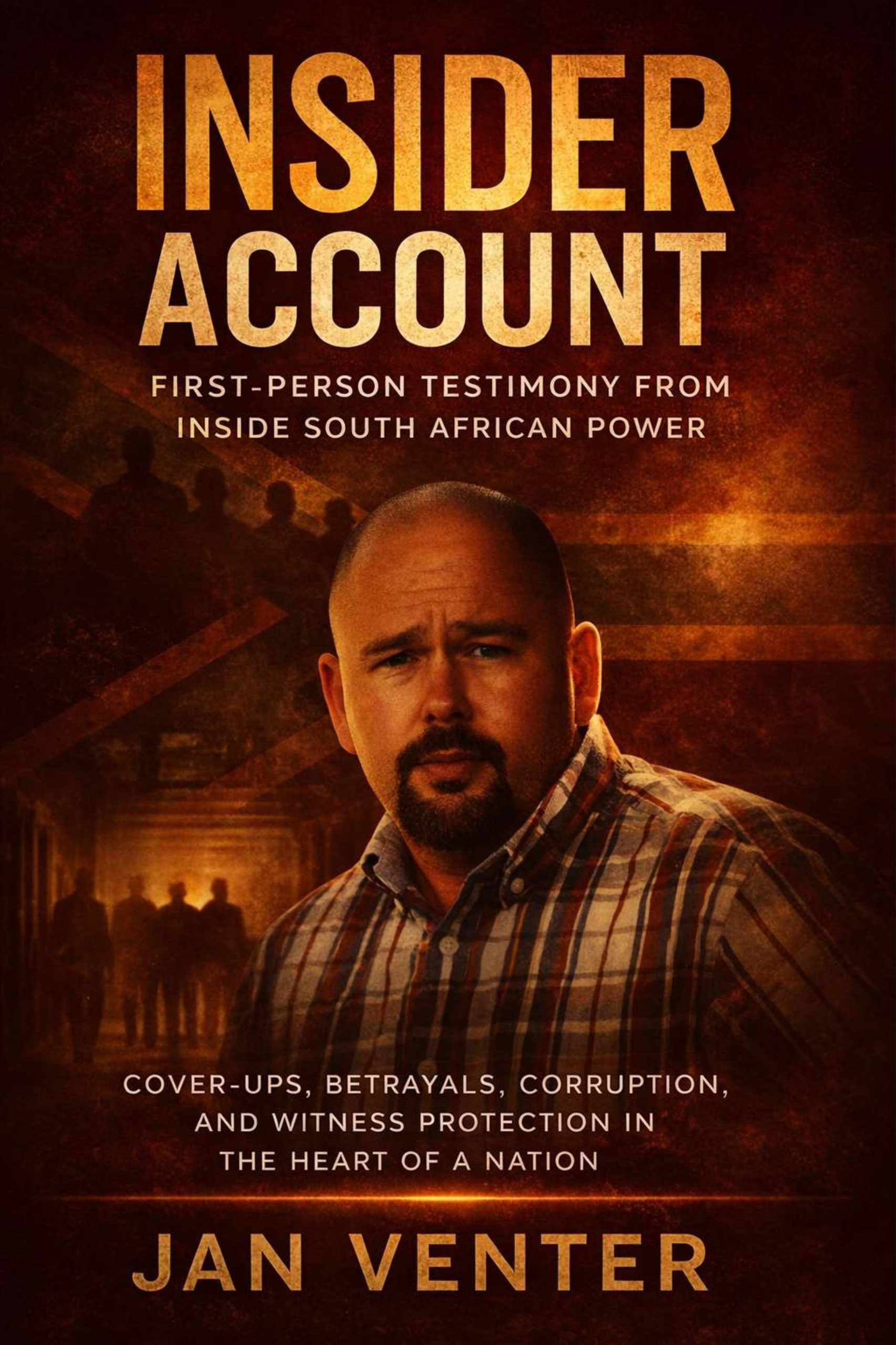
The human record in INSIDER ACCOUNT: First-Person Testimony from Inside South African Power starts with security and operational work, not high office. It follows access, political entanglement, witness protection, prison and the cost of having no office-holder’s shield. Electronic ISBN 978-1-0483-7529-9. Amazon Kindle pre-order or international ebook retailers.
Explore INSIDER ACCOUNTSO I WROTE AGAIN
SO I WROTE AGAIN: When the Witness Became the Problem puts first-person memory beside messages, correspondence, judgments, reporting, denials and adverse material. When a reliable document defeats recollection, the document wins. Electronic ISBN 978-1-0483-7530-5. Amazon Kindle pre-order or international ebook retailers.
Explore SO I WROTE AGAINTHEY HAD THE FILE
THEY HAD THE FILE: What Happened After the Republic Received the Evidence traces recorded receipt, referral, investigation, official responses, decisions and unresolved questions. It separates acknowledgement from proof and investigation from guilt. Electronic ISBN 978-1-0483-7531-2. Amazon Kindle pre-order or international ebook retailers.
Explore THEY HAD THE FILEMATHEWS PHOSA, DAVID MABUZA AND THE PUBLIC FIGURES AROUND THE EXPOSÉ RECORD.
Public names help readers locate the political terrain, but a name appearing in a memoir is not proof of wrongdoing. Exposé connects people and institutions only to the specific public record in which they actually appear.
Mathews Phosa
Mathews Phosa is a lawyer, liberation-era ANC figure, former Premier of Mpumalanga, former ANC Treasurer-General and author of Witness to Power. He is central to the early Exposé chronology through Jan Venter’s publicly documented professional relationship with him, later disputes, journalism, litigation and court records.
David Mabuza
David Mabuza served as Premier of Mpumalanga, ANC Deputy President and Deputy President of South Africa. He died on 3 July 2025. Mabuza is central to the later Exposé political and legal chronology, including Mabuza v Phosa, public reporting about payments, witness-protection reporting and later documentary and institutional material.
Julius Malema
Julius Malema appears in parts of the wider public and court-reporting terrain connected to the Phosa–Mabuza chronology and in later public accountability material. His presence here is contextual and source-led, not an assertion of wrongdoing.
Paul O’Sullivan
Paul O’Sullivan appears in independent reporting concerning Jan Venter’s later approaches to investigators and in public Commission material. Exposé distinguishes public statements, investigative activity and testimony from final institutional findings.
Fred Daniel • Rehana Rossouw • Predator Politics
Fred Daniel and Rehana Rossouw’s published political-nonfiction terrain intersects with the broader David Mabuza and Mpumalanga subject universe. Jacana’s Predator Politics provides an independent published record that readers can examine alongside the separate Exposé chronology.
Witness Protection • Hawks / DPCI • NPA
Witness protection, the Directorate for Priority Crime Investigation and prosecutorial structures form a major part of the trilogy’s later terrain. Public reporting confirms parts of that chronology, while the books distinguish protection, investigation, prosecution decisions and findings.
Madlanga Commission • Parliamentary Oversight
The later Exposé record extends into formal submissions, public proceedings and oversight structures. The project records delivery, receipt, evidence, testimony, requests and institutional responses without turning submission or testimony into a finding that has not been made.
SOUTH AFRICAN POLITICAL MEMOIRS, POLITICAL INSIDER BOOKS AND DOCUMENTARY NONFICTION.
People searching for South African political memoirs, best South African political books, political insider books, African political memoirs or documentary nonfiction may be seeking different things. Exposé offers an unusual outsider-with-inside-access viewpoint, presented in English and available for international ebook pre-order through Amazon Kindle and participating Apple Books, Kobo, Barnes & Noble, Smashwords, Tolino, Fable, Bookshop.org and other global retail channels. Availability varies by country.
NOT JUST A MEMOIR. A LARGE, FINISHED, FACTUAL PROPERTY WITH MULTIPLE WAYS IN.
For international publishers, booksellers, documentary producers and readers following African politics, the question is why this vantage point matters. The writer is not the president or minister looking out from a position of authority; he is the operational participant looking inward without a political title. Three complete manuscripts, the public-source trail, a controlled archive and material adverse to the author give a serious buyer the means to evaluate the claim rather than rely on promotional language. English-language ebooks are offered through international channels; screen, audio, translation and territorial-rights enquiries follow separately.
Three completed manuscripts
Approximately 155,000 words, 165,000 words and 151,000 words respectively — about 471,000 words across a completed trilogy that can be evaluated title by title or as one connected property.
The archive creates a second narrative
The story does not end with retrospective testimony. Communications, reporting, court material, official correspondence, adverse findings and institutional handling can create a parallel documentary timeline for factual development.
Three movements, not one exposition dump
Book One provides the human transformation, Book Two the confrontation with the archive, and Book Three the institutional aftermath. That separation gives film, television and documentary teams distinct dramatic engines rather than one overloaded chronology.
More than one commercial route
Publishing, documentary, film, television, audio, translation, territorial and international rights can be discussed separately or together, with the underlying archive available for controlled professional diligence where appropriate.
The commercial proposition is simple: the story is finished, the record exists, and the buyer can test both.
That combination materially reduces the gap between an authorial pitch and a diligence-ready nonfiction property. Exposé is not asking the market to fund the creation of the core story; the manuscripts and evidentiary architecture already exist.
SOUTH AFRICAN POLITICAL MEMOIRS: THE QUESTIONS BEHIND THE CATEGORY.
Is INSIDER ACCOUNT a South African political memoir?
Yes. It is a first-person South African political memoir by a participant who worked close to political figures without holding elected office. That outside-office viewpoint distinguishes it from autobiographies by former presidents, ministers and party leaders.
Is Jan Venter an investigative journalist?
No. That distinction is fundamental. He is the participant whose own life, memory, conduct and credibility are part of the story. The documentary method enters because the later books test the participant’s account against surviving records.
What makes Exposé a documentary memoir?
The archive is allowed to challenge the narrator. Emails, judgments, public reporting, official correspondence and other records may support, qualify or contradict recollection, and those conflicts remain visible.
Does Exposé claim that every allegation in the memoirs is proved?
No. Exposé distinguishes allegation from finding, receipt from validation, investigation from conclusion, and a transaction from an inferred purpose.
Why is Mathews Phosa relevant to Exposé?
Mathews Phosa is part of Jan Venter’s publicly documented professional and later legal/public chronology, and Phosa’s own Witness to Power provides a useful literary contrast: memoir from senior formal political leadership versus memoir from operational proximity outside office.
Why is David Mabuza relevant to the Exposé record?
David Mabuza appears in the political, legal and documentary chronology that includes Mabuza v Phosa, public reporting, witness-protection reporting and later institutional material. Exposé preserves adverse findings against Jan Venter as well as the material he relies on.
Is Exposé a whistleblower memoir?
It overlaps with whistleblower nonfiction because witness protection, reporting to institutions and the consequences of supplying information form part of the story. But the trilogy is broader: it begins as lived political memoir, becomes documentary reconstruction and ends as institutional accountability nonfiction.
What makes the trilogy different from one ordinary memoir?
Its three volumes test the same South African life from three angles: living beside political power without its formal protection; testing that account against documents; and investigating the subsequent institutional record. This makes the trilogy relevant to readers beyond South Africa as well.
Which South African political memoirs and political nonfiction books are useful comparisons?
Useful comparison points include Nelson Mandela’s Long Walk to Freedom, Mathews Phosa’s Witness to Power, Ronnie Kasrils’s Catching Tadpoles, André de Ruyter’s Truth to Power, Mzilikazi wa Afrika’s Nothing Left to Steal, Helen Zille’s Not Without a Fight, Mosilo Mothepu’s Uncaptured, Themba Maseko’s For My Country, Athol Williams’s Deep Collusion, Pieter-Louis Myburgh’s Gangster State, Mandy Wiener’s Ministry of Crime and Rehana Rossouw’s Predator Politics.
YOU DO NOT HAVE TO BELIEVE THE MEMOIR. YOU CAN TEST THE PROPERTY.
For readers in South Africa, across Africa and internationally, Exposé is a political memoir trilogy written from outside political office and looking in. It examines the price of proximity without the institutional authority held by the people whose world the narrator entered. For publishers, documentary teams and rights buyers, approximately 471,000 completed words connect to a controlled archive and public-source trail. The proposition is not “trust the author.” It is “test the author, test the documents, test the institutions — then decide.”