THE BOOKS TELL THE STORY. EXPOSÉ HOLDS THE RECORD — AND TESTS POWER AGAINST IT.
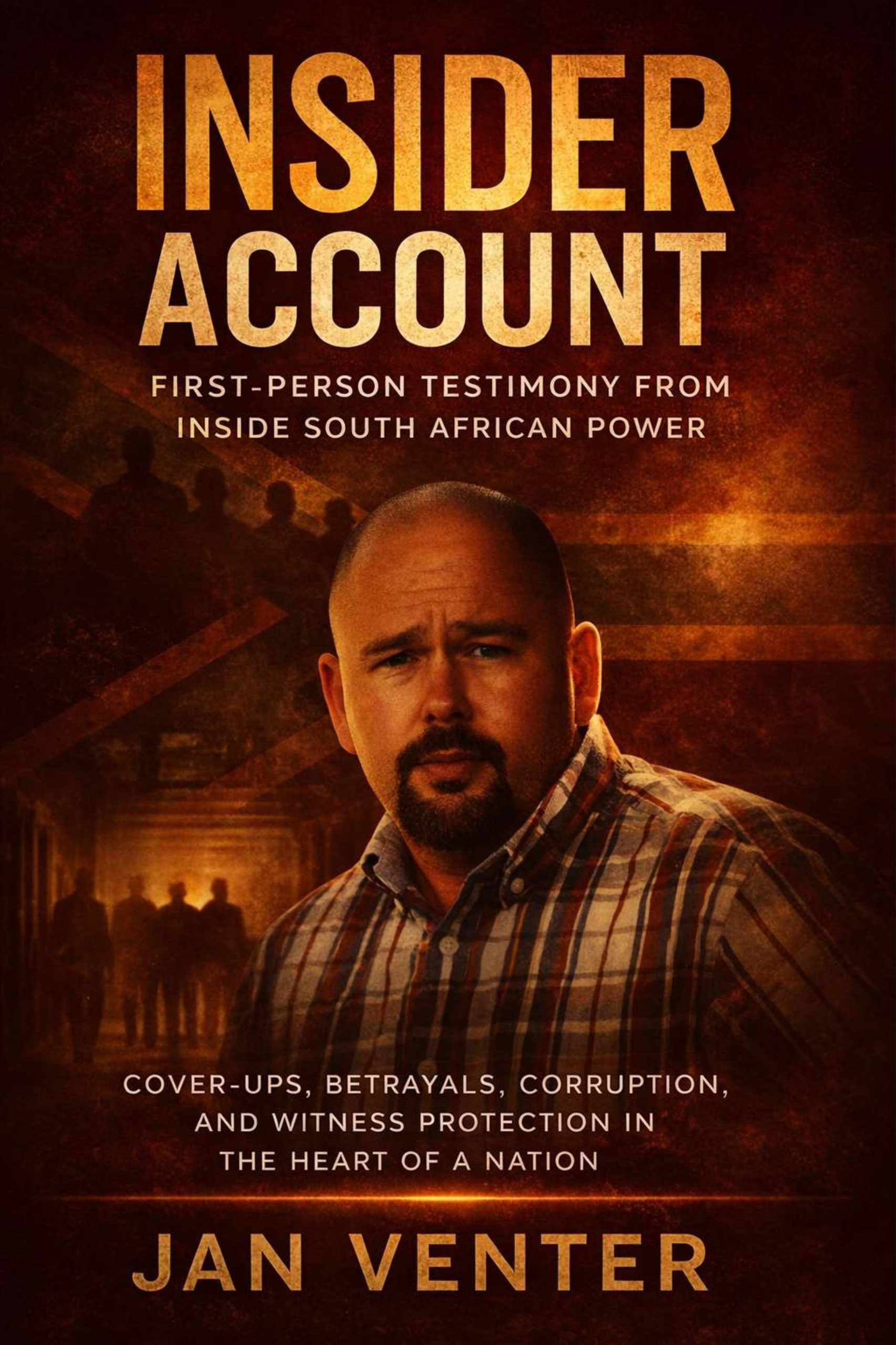
Exposé is the independent publishing, documentary, Public Record, verification and rights platform created by South African author Jan Venter around INSIDER ACCOUNT, SO I WROTE AGAIN and THEY HAD THE FILE — three completed nonfiction manuscripts, together approximately 471,000 words, forming one continuing South African political-memoir and documentary property.
The archive was not assembled after the fact simply to market a memoir. Much of it was generated while the life itself was unfolding: emails, messages, payments, photographs, recordings, court papers, institutional correspondence and public reporting became part of a chronology reflected in the Exposé Public Record. Its public-source intersections include Mathews Phosa, David Mabuza, witness protection, the Directorate for Priority Crime Investigation (DPCI/Hawks), the National Prosecuting Authority (NPA) and later Madlanga Commission material, with the institutional trail organised through the Exposé State Institutions record.
That does not mean every document proves every allegation around it. Exposé is designed to survive scrutiny, not escape it: chronology is preserved, each source is limited to what it can actually establish, adverse material stays in the record, and memory is kept separate from inference, allegation, denial, institutional receipt and judicial finding. The point is not to make the story safer for powerful people. The point is to make the story testable.
The three books are complete, their official electronic ISBNs have been allocated, release dates have been fixed and pre-order distribution is underway. INSIDER ACCOUNT and SO I WROTE AGAIN release on . THEY HAD THE FILE releases on . The full ebooks are scheduled for delivery to readers only on their respective release dates. The publication process is now active across external retail and distribution systems; it is no longer merely a private manuscript programme sitting on the author’s desk.
Exposé was not commissioned by a political party, newsroom, NGO, NPO, donor programme, state institution, corporate sponsor or publisher. Jan Venter built it on his own initiative, without an institutional legal department or funded research team behind the project. That independence is not presented as proof that every claim is correct. It means the record must carry its own weight — and remain open to the same scrutiny Exposé directs at public power.
THE BOOKS HAVE LEFT THE DESK. THE RELEASE DATES ARE FIXED.
The Exposé trilogy has moved from completed manuscripts into scheduled international ebook distribution. Pre-orders are underway through participating retailers as listings propagate across their systems. Readers may encounter retailer pages or limited previews before publication, but the complete ebooks are scheduled for release on the dates below.
INSIDER ACCOUNT
First-Person Testimony from Inside South African Power.
Release:
Electronic ISBN: 978-1-0483-7529-9
Ebook price: US$11.99 • approximately R198 at the 9 October 2026 reference exchange rate. Local retailer pricing and exchange rates may vary.
SO I WROTE AGAIN
When the Witness Became the Problem.
Release:
Electronic ISBN: 978-1-0483-7530-5
Ebook price: US$11.99 • approximately R198 at the 9 October 2026 reference exchange rate. Local retailer pricing and exchange rates may vary.
THEY HAD THE FILE
What Happened After the Republic Received the Evidence.
Release:
Electronic ISBN: 978-1-0483-7531-2
Ebook price: US$12.99 • approximately R215 at the 9 October 2026 reference exchange rate. Local retailer pricing and exchange rates may vary.
Retail: Amazon Kindle, Apple Books, Barnes & Noble / NOOK, Kobo, Tolino, Vivlio, Smashwords, Gardners, Bookshop.org and Fable. Subscription: Everand and Kobo Plus. Library distribution: OverDrive, Vivlio Libraries, cloudLibrary, Hoopla and BorrowBox. Amazon Kindle is supplied directly through Amazon KDP; the selected wide retail, subscription and library channels are supplied through Draft2Digital. Google Play Books is not part of the current distribution programme. Individual retailer pages may appear at different times because each platform controls its own processing and listing schedule.
A STORY CHANGES WHEN THE RECORD SURVIVES IT.
Book One gives the human record. Book Two places documentary material beside that memory. Book Three follows the record into institutions after they received it. Exposé is the infrastructure that keeps those layers connected without pretending that memory, documents, allegations, official action and findings are the same thing. That three-stage method is also what distinguishes the project within the wider field of South African political memoirs: experience is narrated, the archive is opened, and institutional handling is then traced as a separate evidentiary question.
Chronology
Dates, meetings, communications, payments, court events, reporting and official responses can be aligned so sequence is not left to memory alone.
Primary Material
Emails, messages, photographs, financial material, recordings and contemporaneous documents can illuminate what existed while events were unfolding.
Public Record
Judgments, pleadings, journalism, official statements and institutional correspondence preserve versions beyond the author’s own account.
Contradictory Material
Adverse findings, denials, competing accounts and material that challenges the author remain part of the record because scrutiny is stronger when contradiction stays visible.
FROM FIRST-PERSON ACCOUNT TO PROFESSIONAL SCRUTINY.
Select a stage. The strength of Exposé is not merely that material exists; it is that a serious reader can understand how a claim moves from narrative into source, context, contradiction and controlled review.
The First-Person Account
The starting point is the first-person account: what the author remembers, says he experienced, or reconstructs from chronology. Memoir remains memoir; it is not disguised as a legal finding.
THE ARCHIVE HAS LAYERS — NOT ONE UNCONTROLLED VAULT.
Different source classes answer different questions. Select a layer to see what the material can establish and which limits remain attached to it.
Communications
Emails • messages • correspondenceCommunications can establish that people were in contact, what was said in a particular exchange, when an issue was raised and how parties responded at the time.
They do not automatically prove that every statement inside the communication was true. Sender, recipient, date, surrounding messages and original context matter.
Financial Material
Payments • records • transaction contextFinancial material can establish that a payment or transaction occurred, the amount, timing and parties reflected in the surviving record.
A transaction does not by itself establish motive or purpose. Those conclusions require separate contextual support and remain distinct from the payment record itself.
Court & Official Records
Pleadings • judgments • correspondence • institutional recordCourt and official materials can establish what was formally pleaded, decided, denied, recorded or communicated by institutions at a particular time.
A pleading proves what a party put before a court; it is not automatically a factual finding. Judgments and orders are treated according to what the court actually decided.
Journalism & Public Record
Reporting • official statements • competing versionsContemporaneous reporting and public statements can show what was being said publicly, when allegations or denials entered circulation, and whether parts of the story existed before the books were written.
Reporting remains reporting. Exposé distinguishes publication of an allegation from independent proof that the allegation is true.
Images, Recordings & Other Media
Photographs • audio • visual source materialPhotographs, audio and other media may establish presence, appearance, voice, setting, sequence or the content of a recorded exchange where authenticity and context can be assessed.
Like every source class, they remain subject to provenance, completeness, privacy, legal restrictions and the difference between what is visible or audible and what must still be inferred.
PUBLIC POWER IS NOT ENTITLED TO A SHIELD FROM PUBLIC SCRUTINY.
Political leaders, public officials, office-bearers and institutions enter public life through office, influence, public statements, television appearances, campaigns, decisions and records that affect other people. Exposé takes a simple position: public conduct can be scrutinised. Scrutiny does not become illegitimate merely because it is uncomfortable, disputed or damaging to a preferred public image. The answer to evidence-led scrutiny is evidence, correction, denial, context or a competing record — and those responses can be preserved and tested too.
What Exposé does
- Preserves context: dates, senders, recipients, sequence and surrounding material remain connected where available.
- Separates source types: recollection, communication, payment, photograph, pleading and judgment do different evidentiary work.
- Scrutinises public conduct: public statements, public records, institutional actions and documented contradictions can be examined without pretending that scrutiny itself proves wrongdoing.
- Retains adverse material: denials, contradictions and findings that complicate the books stay in the professional record.
- Controls access: private and sensitive material remains subject to law, privacy obligations, source protection and applicable court orders.
What Exposé does not do
- It does not confuse public scrutiny with unlimited disclosure: the distinction between public conduct and protected private material remains deliberate.
- It does not call every allegation proven: uncertainty and unresolved disputes remain identified as such.
- It does not erase hostile material: adverse public records are not removed merely because they are inconvenient to Jan Venter or the books.
- It does not grant the author immunity: where a document corrects recollection, the document wins; where the record remains disputed, the dispute remains.
- It does not replace professional judgment: publishers and producers remain responsible for their own editorial, legal and factual review.
Many newsrooms, NGOs, NPOs, advocacy organisations, established publishers and Chapter 9 institutions operate through formal budgets, staff and institutional systems, and may have access to researchers, professional advisers or legal resources. Exposé did not begin with that machinery. Venter assembled, preserved and organised the project on his own initiative, without party, corporate, NGO/NPO, donor or state-institution backing. That lack of backing does not make the record true by itself. It makes the test cleaner: the documents, chronology and public record must stand or fall on what they actually show.
THE ARCHIVE CHANGES WHAT THE PROPERTY CAN BECOME.
The three completed books carry the human story from lived experience, to documentary reconstruction, to institutional response. They are now in scheduled international publication and distribution. Exposé gives professional audiences a structured way to assess, develop, adapt and diligence the underlying property beyond the ebook publication route. For a producer, documentary team, rights professional, editor or legal reviewer, the proposition is not simply “trust the memoirist”: it is three finished books beside a source architecture built to expose both supporting and damaging material.
Published Editions & Rights
The ebooks now have fixed release dates and international distribution routes. Editors, rights professionals and legal reviewers can assess chronology, contrary records and selected originals where appropriate for territorial, translation, audio and related rights work.
Documentary
Contemporaneous communications, public reporting, institutional responses, images, recordings and retrospective testimony create an archive-led factual structure.
Film & Television
The record helps producers and screenwriters distinguish documented chronology from adaptation choices while developing a feature or premium limited series.
International & Audio
A disciplined source layer makes this South African political memoir and documentary property easier to explain across territories and formats without reducing the story to unsupported political allegation.
That combination gives serious rights and adaptation partners more than a pitch: approximately 471,000 words across a finished human narrative, a finished documentary reconstruction, a completed institutional third movement and a controlled body of underlying material capable of supporting factual development, screen adaptation, audio, translation and territorial exploitation. No political party, NGO, NPO, state institution, corporate sponsor or donor commissioned the trilogy; the property must therefore be judged on the books, the chronology, the archive and the public record themselves.
THE WEBSITE SHOWS THE ARCHITECTURE — NOT THE ENTIRE ARCHIVE.
Public visitors can understand the books, the narrator’s position, the categories of surviving material and the evidentiary method without unrestricted access to sensitive originals.
That keeps the site useful to readers and commercially legible while protecting privacy, legal obligations, source integrity and material that belongs in a controlled professional setting.
QUALIFIED REVIEWERS CAN GO DEEPER.
Editors, legal reviewers, producers, directors, screenwriters, documentary teams, translation partners, audio partners and territorial-rights professionals may require claim-specific material, chronology, adverse records, selected originals or controlled manuscript access as part of serious due diligence.
Access is selective, purpose-specific and subject to applicable law, privacy obligations and existing court orders. A request does not automatically create entitlement to the complete private archive.
THE HUMAN RECORD. THE DOCUMENTARY RECORD. THE INSTITUTIONAL RECORD.
Exposé connects the series without collapsing the distinctions between its parts.
INSIDER ACCOUNT
The human record. Book One is complete and scheduled for release on 31 October 2026: the lived chronology, private proximity, consequence and first-person reconstruction. Electronic ISBN 978-1-0483-7529-9.
SO I WROTE AGAIN
The documentary record. Book Two is complete and scheduled for release on 31 October 2026: memory placed beside emails, messages, official records, court material, acknowledgements, denials and contradictions. Electronic ISBN 978-1-0483-7530-5.
THEY HAD THE FILE
The institutional record. Book Three is complete and scheduled for release on 15 November 2026: the narrative follows what happened after institutions themselves received the record — including acknowledgement, referral, investigation, regulatory handling, decisions, delay, dispute and the continuing limits of what the record can establish. Electronic ISBN 978-1-0483-7531-2.
Exposé
The infrastructure. Archive control, chronology, source discipline, publication-status reporting, international distribution information, rights pathways, professional access and the platform connecting the books to readers, libraries and serious rights or adaptation partners.