DAVID MABUZA & JAN VENTER: MPUMALANGA POWER, THE MONEY RECORD & THE INTELLIGENCE QUESTIONS
David Dabede Mabuza rose from Mpumalanga politics to the ANC Deputy Presidency and then to the Deputy Presidency of South Africa. Jan Venter says his own life became entangled with Mabuza’s political environment years before most South Africans had any reason to know his name.
This is not a retrospective attempt to attach Venter to a famous public figure. The relationship, the Mabuza v Phosa court record, the documented payment chain, Venter’s later allegations, the Hawks investigation, witness protection and the institutional paper trail all pre-date Mabuza’s death. Venter says he worked for Mabuza and people around him over a period of years, accepted money and benefits, and only gradually came to understand what he believed the wider machinery behind some of those arrangements to be.
Venter does not write himself out of that history. He says he accepted money and assistance for years and accepts responsibility for his own participation. His claim is that the story changed when he began connecting work, cash, political instructions and intelligence-linked relationships — and eventually decided to place his own conduct before investigators even though he believed doing so could expose him personally.
Mabuza died on 3 July 2025. He cannot answer new allegations now. For that reason this page preserves his contemporaneous denials, the public court record and the limits of what later institutional activity can prove. The test is not whether Jan Venter is believed on personality. The test is whether the surviving record can explain the money, the work, the instructions and what happened after the State received the file.
Do not cherry-pick Jan Venter. Do not cherry-pick David Mabuza. Do not cherry-pick the judgment. A memoir claim is not a finding; a denial does not erase the claim it answers; an investigation is not guilt; and a court’s adverse credibility finding does not erase common-cause facts recorded in the same judgment.
FROM MPUMALANGA PREMIER TO DEPUTY PRESIDENT OF SOUTH AFRICA
The strongest David Mabuza page begins with what is not disputed: his public political career, his role in the African National Congress and his movement from provincial to national power.
Mpumalanga
Mabuza served as Premier of Mpumalanga from 2009 until 2018 after holding several provincial executive roles. Mpumalanga is therefore not incidental to the Exposé record; it is the political terrain from which his national influence developed.
ANC Leadership
The ANC records that Mabuza joined the NEC at Polokwane in 2007, became ANC Chairperson in Mpumalanga in 2008 and was elected ANC Deputy President at Nasrec in December 2017.
National Office
After Cyril Ramaphosa became President of the Republic, Mabuza served as Deputy President of South Africa from 2018 to 2023 and as Leader of Government Business in Parliament.
Historical Record
Mabuza died on 3 July 2025. Exposé therefore writes about his public career in the past tense and does not imply that later reporting or later commissions amount to findings against a deceased public figure.
THE “PREMIER LEAGUE”, NASREC AND THE KINGMAKER DESCRIPTION
Mabuza’s national relevance cannot be understood without the ANC, the provincial power blocs of the Zuma era and the 54th ANC National Conference at Nasrec in December 2017.
THIS IS WHERE DAVID MABUZA’S PUBLIC HISTORY COLLIDES WITH JAN VENTER’S PRIVATE WORKING LIFE
Exposé is not a biography of Mabuza written from a distance. It is Venter’s account of how a man outside elected office says he entered Mabuza’s political environment, became useful inside it, received work and money through people around it, and later began questioning what he had actually become part of.
From approach to access
Venter’s account begins while Mabuza was Premier of Mpumalanga. What starts as an approach for assistance develops, in the memoir, into a longer relationship with Mabuza and people around him. That account is tested against contemporaneous reporting, court material and later correspondence rather than presented as self-proving memory.
Work through an intermediary
Venter says a politically connected intermediary later helped secure work for him at Fidelity Security. He says he initially treated that as ordinary employment but later came to believe parts of the arrangement were externally funded. Exposé does not allege that Fidelity Security knew of, authorised or participated in any improper funding mechanism; the disputed question concerns the source and purpose of money as Venter came to understand it.
He does not claim innocence from the sidelines
Venter says he accepted money, work and benefits over a period of years. He accepts responsibility for his own participation. That is central to the trilogy: the narrator is not presented as a spotless observer who discovered wrongdoing from a safe distance, but as a participant who says his understanding changed while he was already inside the relationship.
THEY THOUGHT HE DIDN’T KNOW. AT FIRST, HE SAYS, THEY WERE RIGHT.
Venter’s account is uncomfortable precisely because awareness did not arrive on day one. He says that in the beginning he saw assistance, work, access, cash and instructions as separate events. Later, he began to see a pattern. Whether that later interpretation is correct is something the documents and institutional records must test.
THE INTELLIGENCE QUESTION IS PART OF THE MABUZA STORY — BUT IT STILL HAS TO BE PROVED OR DISPROVED
Venter’s account goes beyond ordinary political patronage. He says he came to believe that some money, work and operational activity around the Mabuza environment was connected to State Security, National Intelligence or Crime Intelligence structures. That remains an attributed allegation. The correct response is not to convert it into guilt — or to dismiss it without obtaining the records capable of testing it.
What Venter says Mabuza told him
Book One records Venter’s recollection that Mabuza spoke about contact at national level and that people Venter understood to be connected to State Security or National Intelligence wanted to meet him. The memoir then records the meetings and tasks as Venter remembers them. That is first-person testimony, not an institutional finding.
The money-source allegation
Venter’s later sworn submissions allege that funds routed through an intermediary and other people in Mabuza’s environment were linked to intelligence structures, including State Security and Crime Intelligence sources. He has asked investigators to obtain bank records, mandates, invoices, authorisations and State records capable of proving or disproving that account.
The official denial stays
In October 2015, The Presidency rejected allegations that Presidency officials had met Venter and described those allegations as untrue and malicious. Exposé retains that denial. It also distinguishes a Presidency denial from the separate question of what other intelligence, policing or political structures may or may not have done.
READ THE WHOLE JUDGMENT: THE SAME COURT THAT SAVAGED VENTER’S CREDIBILITY ALSO RECORDED THE MONEY
Mabuza v Phosa (8018/2015) [2017] ZAGPPHC 139 is devastating to Venter in places. Exposé does not hide that. But the judgment does not end with the credibility attack. It also records material financial facts that cannot be erased simply because the witness was criticised.
Against Venter
Prinsloo J made severe adverse credibility findings about Venter and scrutinised his changing affidavits and evidence. Those findings remain part of the public record and are not softened here.
The money was recorded too
The same judgment records as common cause that, after Venter met Mabuza, he received substantial amounts of money channelled through a legal practitioner and various people who delivered cash. The judge stated that he was left with a strong impression that the money came from Mabuza.
Mabuza did not testify
The judgment records that Mabuza did not give evidence and questions why he did not do so when he could have explained the meeting and the substantial payments that followed. The court ultimately dismissed Mabuza’s defamation claim and ordered punitive attorney-and-client costs against him.
MABUZA’S OWN DENIAL IS PART OF THE RECORD
Fairness requires more than publishing allegations. It requires preserving the response of the person accused and the procedural outcome that followed.
The application
In May 2018, Venter approached court in a protection-from-harassment matter concerning Mabuza. The public record later reflected that the application was struck from the roll and that Venter withdrew claims and statements in that process.
Mabuza’s response
An official Presidency statement recorded Mabuza’s position that Venter’s allegations were false, malicious and an attempt to tarnish his name. That denial is preserved here without softening its language.
Later memoir treatment
The books revisit the chronology, Venter’s own reversals and the documents that followed. They do not convert later self-explanation into a retrospective court victory that never occurred.
HE WENT TO THE HAWKS KNOWING HE MIGHT BE ARRESTED HIMSELF
This is Venter’s account of the point at which participation became disclosure. He says he approached the DPCI/Hawks voluntarily in 2018, intending to describe not only what he alleged others had done but also his own involvement. He says he believed there was a real possibility that the disclosure could expose him to arrest.
Not a clean-hands narrative
Venter says he did not go to investigators claiming to have watched everything from the outside. He says he described money, benefits, work, political influence and intelligence-linked activity in which he himself had participated. That admission is part of the reason the trilogy can be tested against more than self-exculpatory memoir.
Witness Protection
Independent reporting records that Venter later spent approximately fifteen months in the National Prosecuting Authority’s witness-protection programme. Placement in protection is a State action; it is not a judicial finding that Mabuza or any other named person committed an offence.
The retained DPCI record
Venter’s retained later DPCI correspondence describes the underlying investigation as prosecutor-guided and refers to more than fifty affidavits and bank statements. Exposé treats that as documentary evidence of what the DPCI recorded about its investigation — not as proof that every allegation within the file was true.
THE MABUZA, MONEY AND INTELLIGENCE QUESTIONS WERE ALREADY IN VENTER’S COMMISSION FILE
The importance of the Madlanga record on this page is chronological. Venter did not wait for later public hearings to begin speaking about Crime Intelligence, State Security, intelligence-linked money or David Mabuza. His retained submission trail shows those themes were already being placed before the Commission under a traceable reference.
1 October 2025 • reference 016004
Venter’s archive records a formal disclosure to the Commission concerning alleged Crime Intelligence and State Security-linked funds, criminal-justice concerns and Mabuza-related material. The Commission-linked intake process issued reference 016004. A reference proves receipt and registration at an intake level; it does not prove the allegations.
Repeated formal submissions
The retained chronology records at least eight separate Commission-facing submissions, applications, supplements, demands or full-bundle transmissions by May 2026, followed by further supplementary material later in the year. The filings repeatedly asked for source tracing, bank records, mandates, intelligence records and linkage of the Mabuza-related branch.
20 May 2026 • investigative team
After a large compiled evidentiary transmission, the Commission told Venter that his matter was with the investigative team and that no further material was required unless investigators requested it. That is meaningful procedural handling. It is not a finding, endorsement or validation of Venter’s allegations.
DAVID MABUZA IS NOT A NAME DROPPED INTO THREE BOOKS — HE IS A THREAD TESTED THREE DIFFERENT WAYS
The trilogy does not give one narrator three opportunities to repeat the same accusation. Each completed manuscript changes the evidentiary question and therefore changes what the Mabuza material is required to survive.
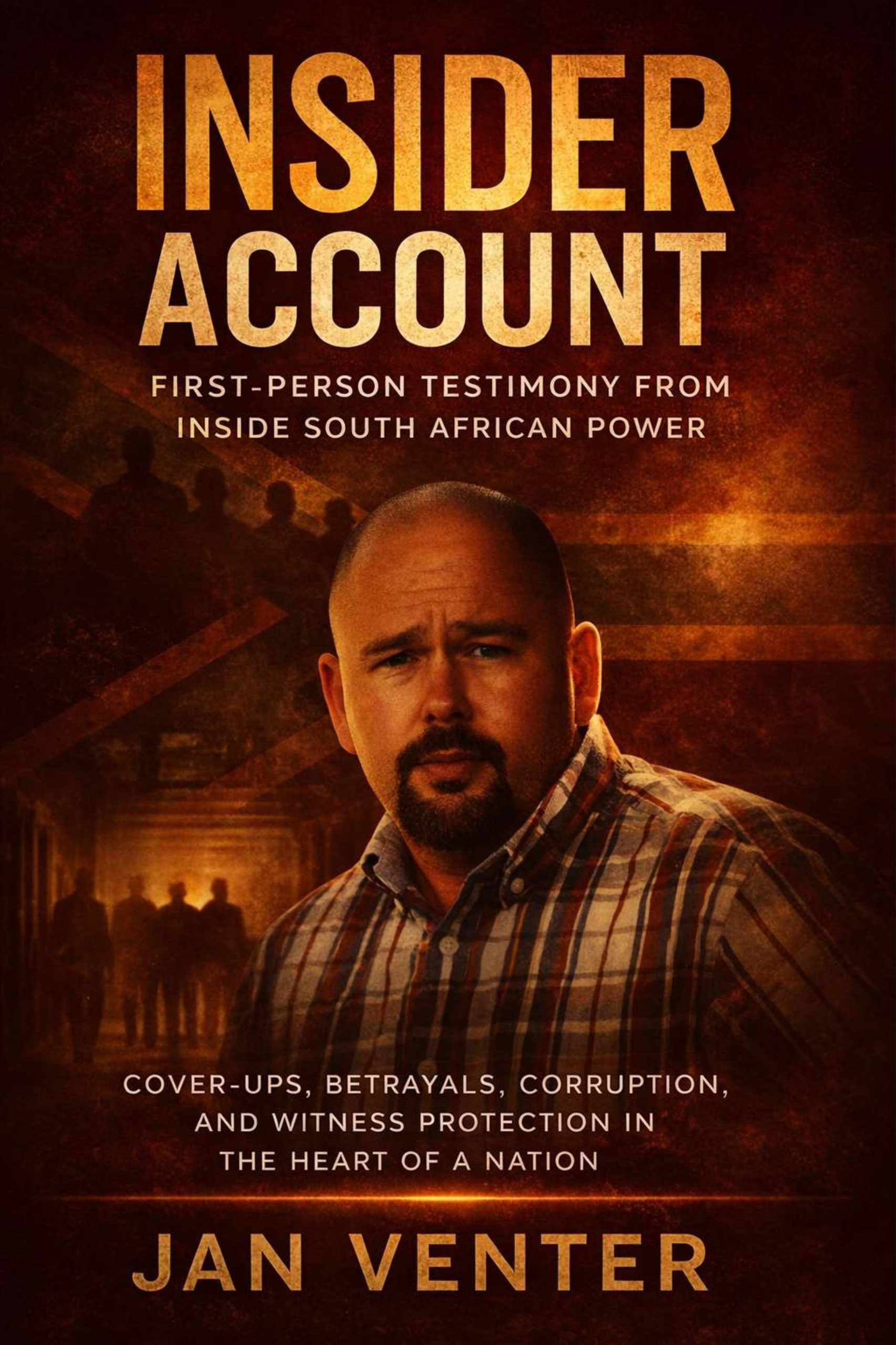
INSIDER ACCOUNT — The Human Record
Approximately 155,000 words. The lived story: Venter’s route into Mabuza’s environment, work, access, money, shifting loyalties, what he says he understood at the time and what he says he failed to understand until later.
SO I WROTE AGAIN — The Documentary Record
Approximately 165,000 words. The archive challenges the narrator: court records, correspondence, payment material, denials, hostile findings and documents that may correct Venter. Where a reliable document defeats memory, the document wins.
THEY HAD THE FILE — The Institutional Record
Approximately 151,000 words. The question becomes what happened after institutions received the material: Hawks, prosecution decisions, witness protection, review routes, Commission submissions, registration, investigation and reasons.
WHY THE DAVID MABUZA THREAD HAS COMMERCIAL WEIGHT
For a publisher, producer or rights buyer, this is not one accusation waiting for a dramatic headline. It is a long-form factual property with a beginning, reversal and institutional afterlife — anchored to a former Premier, ANC Deputy President and Deputy President of South Africa, but told from the position of a participant below formal political office.
Character transformation
The narrator says he began as a useful participant who accepted the benefits of proximity, then gradually realised that he may not have understood the system he was serving. That gives the story moral complication rather than a clean hero-villain structure.
Built-in adversarial tension
The principal High Court judgment attacks Venter’s credibility yet records the payment chain as common cause and questions Mabuza’s failure to explain it in evidence. The property therefore contains conflict inside the primary record itself.
An institutional third act
The story does not end when the political relationship ends. It moves into the Hawks, witness protection, prosecution decisions, institutional review and Commission-era handling. That creates a natural documentary and limited-series structure.
Completed and diligence-ready
Approximately 471,000 completed words across three manuscripts sit beside a public-source trail and controlled archive. Serious buyers can test the property before committing editorial or production capital rather than being asked to purchase a pitch on trust.
The proposition is larger than one man’s allegation.
The commercial question is whether a participant’s transformation from useful insider to self-implicating source can survive the judgment, the money record, the denials and the State’s own files. That is the property.
DON’T TAKE THE MABUZA PAGE ON TRUST. OPEN THE OTHER RECORDS.
This page stays tightly centred on David Mabuza and Jan Venter. The broader documentary and institutional architecture is deliberately separated into companion pages so the reader can follow the evidence without confusing political context, personal testimony and State handling.
Jan Venter Public Record
Favourable, hostile, neutral, judicial and official material is preserved side by side.
State Institutions
The wider Hawks, NPA, witness-protection, intelligence, Commission and oversight chronology belongs here rather than being allowed to overwhelm the Mabuza page.
Mathews Phosa Record
The companion political and court record provides the other side of the Mabuza v Phosa chronology.